Sunday, 6 December 2020

Nijmegen Bridges

 Tim C put on a very entertaining and original game covering the attacks on the bridge at Nijmegen undertaken by the Germans after Operation Market Garden ended. OKW were very unhappy about having allied units sitting right next to the Rhine, and were determined to push them back across the Waal again, and to this end focused their efforts on destroying the two bridges at Nijmegen to isolate the troops on 'The Island' between the Waal and the Rhine.


This is one of the bridges, quite an imposing thing to try and destroy. The Waal is a big river, with big bridges to match.


The bridges were slap bang in the middle of Nijmegen, with both shores controlled for several km in either direction by the Allies.

The game was set between 25th and 28th September 1944, and we were tasked with destroying both bridges. Tim G commanded the Luftwaffe contingent, John got the Heer, while I ended up commanding a detachment of twelve Kampfschwimmer a.k.a. Nazi Frogmen, Oh yes.


These chaps were elite German Navy assault divers, trained initially by the famous Italian combat divers who had so much success in the Mediterranean.

This was essentially a planning game. The Luftwaffe and Heer had a certain resources (aircraft, artillery, ammunition) they could employ, while the frogmen essentially had enough mines to make a single attack. The frogmen would have to work in teams, as each mine required two divers to float to the target and then deploy (they split in half to wrap around each side of the bridge piers). As overall commander I organised the diver teams and allocated targets. The river had a strong current so I thought there was a high risk we'd miss the designated targets, so the teams designated to attack the road bridge upstream had secondary targets at the rail bridge further down.

We then had a good back and forth about the tactics to employ. I'd favoured motoring to within a couple of km of the bridge under cover and artillery barrage and swimming from there, but after some discussion and further research we decided the divers were fit enough and well equipped to swim/float the 10km from our launch point to the target  so we opted for a silent attack with the divers camouflaged as river debris. Then we'd mine the bridges, and float a further 5km downriver and back to our own lines. Simple!

Meanwhile the Luftwaffe planned a series of air raids at both day and night, which we carefully timed to avoid the diving attack, while the Heer analysed the chances of destroying the bridge with artillery fire and decided it was futile. Instead they fired Flak suppression missions  to support the Luftwaffe and harrassing fire missions to keep the defenders on their toes. Allied air dominance meant the guns had to relocate after firing a few rounds.

The 26th dawned with a Luftwaffe raid by 40 FW-190s. Unfortunately thick fog socked them in and they didn't get airborne until 10am. They had a decent run in and actually scored three hits on the road bridge, but as Allied commanders also discovered, it is really, really hard to destroy bridges with WW2 era airborne weapons systems. They jabos were bounced by the RAF on the way back to base and slaughtered, losing 30 aircraft. Ouch!

:Later than night, the frogmen entered the river 10km upstream at 2330, and once they were in the water it was pretty much each pair to their own. Five of the teams were run by players (me, Jerry, Mark, Tom and Pete) and one pair was non-player characters. At midnight the Luftwaffe tried again with night equipped Ju 87s . Once again, little damage was scored (the bombs mainly hitting the bridge upperworks and detonating prematurely) and the Stukas were bounced by radar equipped night fighters and shot to pieces. Tim now had little left to command and was offered command of the sixth diver team, but wisely declined.

At this point we switched to the scale model of Nijmegen and the Waal river.


Each diver pair is represented by a pair of dice. I'm red, blue was Pete, white was Tom, green was Jerry, black was Mark and yellow were the NPCs.


We all got a bit scattered going down the river. The current varied in speed and the banks were muddy and clogged with debris, which wasn't ideal when towing a large naval mine! Pete got hung up on the bank but got free again.


I ended up in the lead. As we approached the bridges we could see searchlights playing on the water so I opted to submerge. We had 30 minutes of oxygen. The red dice above are my team busy laying our mines around the southern pier of the road bridge. Tom's team in white are sweeping past en route to their target of the southern pier of the rail bridge. I'd allocated one team per bridge pier, with some doubling up against the road bridge (which only had two piers). 


Jerry (green) has caught up now and is also en route to the rail bridge (cente pier). Despite my misgivings, we didn't seem to have any problems getting to our allocated piers, although Pete heard a random rifle shot.


Mark (black) has caught up now and is mining the north road bridge pier. Yellow had the same target and is waiting for Mark to clear the area. I was finished and floating off downstream past Tom and Jerry, with us all still submerged.


Jerry, myself and Tom made good out escape downstream, but our air ran short and we had to surface a bit soon.  Mark also finished mining the road bridge, as did yellow, so we had three mines on the road bridge and two on the rail bridge. Pete (blue) was still heading for the rail bridge, but at this point a keen eyed sentry spotted one of the diver teams downriver and the alarm was raised. 

The three remaining teams tried to get away, but yellow and blue got hung up on a pontoon laid under the rail bridge and were taken prisoner. Mark (black) got away. Pete was captured, but despite being tied to one of the bridges by an over zealous Britsh officer, he didn't give the game away. Good man! Half an hour later the mines went off (albeit with two duds), which was enough to bring down a span of each bridge, Hurrah!


This was the rail bridge after the real attack. The bridge supports were far too thick to be destroyed by the mines, but the shock was transmitted up them and dislodged the bridge span from the top of the pier.

Irl the rail bridge was brought down (as indicated above) but the road bridge had a large section of one span blown out, which was repaired by putting a Bailey Bridge over the gap!  

That was great fun and a real change from our more normal games.


Thursday, 3 December 2020

Sudan Colonial part 1. British

This little project demonstrates the perils of eBay browsing. While I've had a vague interest in Colonial warfare, when it comes to chaps in Khaki Drill I've more been playing Mesopotamia and Palestine in WW1. Well, sadly a very cheap lot of  unpainted 15mm Mahdist Wars figures appeared on eBay, and purchasing and painting duly followed.


Here are a couple of British units, with a heroic command base. I really like the look of KD with white webbing so I went for later period figures in Khaki rather than 'Zulu' style redcoats.


These figures are Two Dragons 15mm. I did them on my usual 30x30 bases but with three figures in line, which I think looks rather nice.


The commander is on his horse. I can't remember where I got the flags now unfortunately.


You can't do without artillery support, so one of the first things I got to supplement the eBay figures were some guns. A couple of RBLs in this case.


I think these are Essex, certainly I ended up buying quite a few Essex figures to supplement the Two Dragons ones.


You also have to have a Gatling Gun, so it can jam when the Colonel is dead. Also Essex I think.


A lovely little model.


I did some individually based officers for heroic Harry Faversham type activities. These are a mixture of Two Dragons, Essex and possibly some Peter Pig.


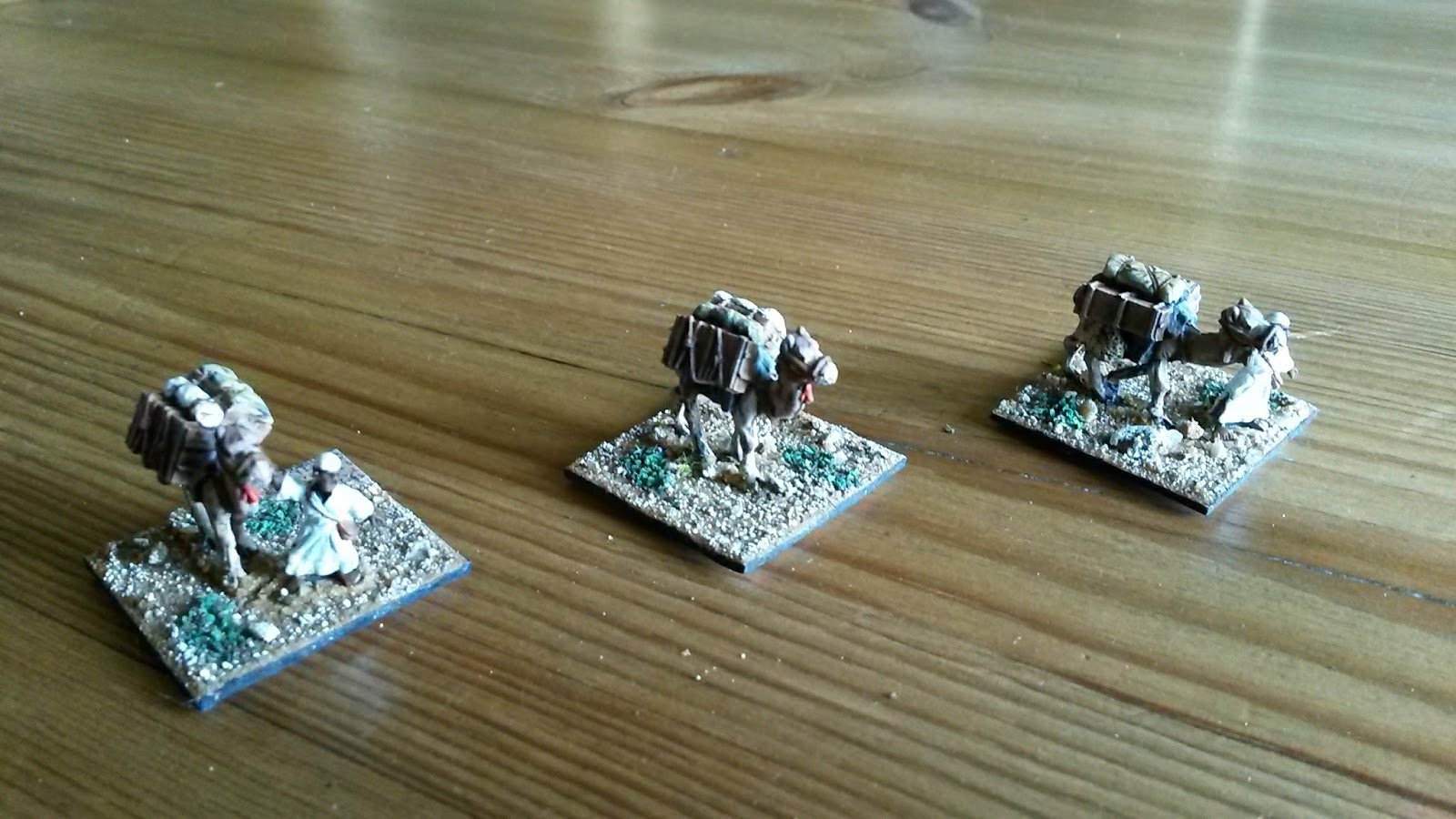
Where the British Army goes, so does its baggage. I got some pack mules, probably Essex, possibly PP. 


I didn't give them any handlers so I could use them for multiple periods. Burma or Italy anyone?


I also got a few pack camels, which add some tone to the proceedings. Along with the pack mules, they are all ideally suited to panicking and disrupting any well ordered square they happen to be standing inside.

Saturday, 28 November 2020

Table Battles - Bosworth

 Tim put on a game using an interesting card game called 'Table Battles' which lets you recreate biggish engagements ranging from Ancients right up to late nineteenth century.

To my mind the rules have something of a heritage of Waterloo 1815 in that the forces are represented by cards, which then describe what the units can and can't do. These include not only the obvious 'attack' type options,  but also things like screening, bombardment etc. There are restrictions on which cards can attack other cards, and unit skill and resilience is modelled by varying the number of hits they can take and the loss ratio they inflict in combat.


Here is the Yorkist battle line for Bosworth. The number in the top right corner is how many hits they can take. The key thing is the number in the squiggly line. This is what dice scores can be used to activate the cards. C3 is modelled by the players throwing half a dozen dice and allocated them to a card based on the scores. In Richards case. Norfolk can take 5s and 6s, Richard himself can only take 5s and Northumberland can only take 4s.  So if you throw a bunch of 1s and 2s, you are stuck.

What is nice is that you can build dice up on a card, so e.g. Norfolk could build up a pile of e.g. 6 dice over a few turns. This would allow him to make a much stronger attack (inflicting one hit per dice, but only suffering one hit overall) at the cost of time.

In this scenario, Northumberland is in reserve, and can only be activated by Richard who needs to build up a whopping five dice to carry out that action.  Richards strategic choice is then essentially to try and fight with the cards he has got at a force disadvantage, or play a longer game and hope he can hang on until Northumberland activates. He only needs to rout one Lancastrian unit to win.


The Tudor army is a real contrast. Oxford  is similar to Norfolk, able to use 5 or 6, ad attacks in a similar manner - losing one hit and inflicting one per dice used. With a strength of eight though, Oxford is a tough nut to crack, and he has to be attacked first by Richards Army. Richmond can use 3 or 4 dice, and has the huge advantage that he can inflict one hit for no loss in combat, even though he only has two strength points. Essentially he is launching short, sharp attacks screened by Oxford, which can chip away at Norfolk and Richard. As he can use 3s and 4s, the Lancastrian Army will also have an advantage in C3 rolls over Richard. The Stanleys, like Northumberland, are lurking in reserve and need to be activated by Richmond.

The Lancastrian strategy is far more straight forward, attack Norfolk as soon as possible. If Norfolk is routed, the Lancastrians gain a morale chip and only need to rout Richard to win (Richards morale is two, the Lancastrians only one).

We ran this game twice over two successive nights and it went really well, although both were Lancastrian victories. Tim even managed to arrange things so multiple players took part (despite each side only having three cards!). Bosworth is just an introductory scenario, and the series includes cards to cover some pretty big historical battles, including e.g. Gettysburg. For the larger battles the armies are divided into wings, with the dice allocated across the wings. It is an interesting take on warfare up until the end of the nineteenth century, and well worth a look.

The boardgame geek entry is here: https://boardgamegeek.com/boardgame/230650/table-battles if you want some more info, video reviews etc.


Thursday, 19 November 2020

20mm Sturmtiger

This one is a bit of an oddity, a Sturmtiger converted from the Airfix one. Although I've done a fair few 20mm conversions, I can't claim the credit for this one, as it came my way via Mr Gow (originally built by his friend JR I think) . 

I gather it was based on an article in Airfix magazine which I must have missed or I might have been tempted myself!


It is essentially just a huge armoured box on a Tiger chassis and armed with a 380mm (!) rocket propelled mortar. Its closest Allied equivalent was the AVRE Petard. This conversion captures the heft of the thing quite well. Unlike the Petard, this one is a breech loader, but the huge size of the rounds meant the internal storage was very limited, so the crane on the back was to help load new rounds through the rear hatch.


The gun barrel here has been converted using a biro pen. The real thing wasn't quite so wide bored as 380mm is only 15", but it does look fairly terrifying.


It sits nicely on the suspension. The turret numbers came out of the spares box.


And the rear deck is suitably imposing with nice dep engine grills. I didn't dirty it up too much, just a bit of mud and drybrushed dust.

All I really had to do with this model was some minor repair work and a new paint job. This example is based on one captured by the US Army in 1945 (several platoons of Sturmtigers fought in the Bulge and at Remagen where they were tasked with destroying the bridge with gunfire!). It has a well defined 'ambush' scheme although the real one had a slightly more dense pattern of spots.


Saturday, 7 November 2020

Norfolk Part 2

 Along with my visit to Muckleborough on our break in Norfolk this summer, we were regular visitors to the local shingle beach, we even swam in the sea a few times although the North Sea is fairly chilly at this time of year. The odd seal came to say hello too, which was a nice bonus.

On the dykes through the salt marshes and on the beach itself were various old defences. Most of the pillboxes had succumbed to the relentless sea, however... 


There was this rather fine specimen half buried in shingle. I'm not convinced North Norfolk would have been the best place to invade Britain, but it was nice to see some of the old defences left. 


Further back in the marshes was this delightful pre fabricated steel pill box, still in its concrete pit. It was missing its hatches but was otherwise in great condition, plenty of space inside for a Bren team plus a few home comforts. 

Along with coastal excursions (which generally seemed to feature eating cakes or scones at some point) we went to see the Anish Kapoor exhibition at Houghton Hall South of Kings Lynn. Along with the permanent and visiting exhibitions, there is a magnificent collection of toy soldiers, well worth the admission price alone. 

The house was established by Walpole in the 1700s and is  close to the Royal Estate at Sandringham,  but the toy soldier collection was started by the 6th Marquess of Cholmondley in the 1920s and now has over 20,000 figures. 

I couldn't really do the whole thing justice, but here are a few things which caught my eye. 


Mounted bandsmen


The British Army in Egypt in review. 


Charge of the Light Brigade 


Camp scenes


British Army review (again). In Britain this time. 


I think this is the relief of Khartoum 


Napoleon and his HQ. 


Wellington (we already met Copenhagen at the Muckleborough Collection) 


Boney


21st Lancers charge at Omdurman. I expect young Lt Winston Churchill is among that lot but I couldn't pick him out. 


Another mounted band. 


Various large scale Napoleonic French (with another Napoleon) 


There is a huge diorama of Waterloo, and unlike the Siborne one, it shows different stages of the battle from each of its four sides. This one is the attack of the Guard. I'll let you work out the two above. What a clever idea and very effective. 


Another camp scene. 


Lots of the dioramas featured flats, here are two examples. 


This is what we actually came to see, more magic from Anish Kapoor. This sky mirror was just astonishing, true interactive public art, like The Bean in Chicago. 

Even if you aren't that bothered about the art (although the gardens are beautiful and worth visiting for the Henry Moore alone) the toy soldiers are just fabulous.