Friday, 14 June 2013

Meet the Vulgarians

My imaginary nineteenth century country of  Vulgaria has featured in several blog posts, particularly on Tim Gows site. It is probably now time for a formal introduction.


Geography

Vulgaria is one of the numerous  Germanic states of Mitteleuropa, mainly comprising extensive flat plains of rich agricultural land bisected by large waterways leading into the interior. The north is bounded by mountains which are also the major watershed, and some of the major rivers empty into the sea on the coast to the northwest where there are major ports and trade centres. To the south and east the country is wide open, although towards the east the terrain bcomes increasingly forested and marshy. There are extensive raw materials in the northern mountains,  particularly coal and iron ore, and the centres of industrial production are here. Originally the waterways comprised them main transport routes, both into Vulgaria and further into Mitteleuropa, but have ben supplemented with an extensive steam railway network. Vulgaria posses a large fleet of river barges as well as a significant merchant marine based in its coastal ports.

A modern steam tug assists barge traffic across the Vulgarian plain
  
Culture

Without natural barriers to the south and east, and at the centre of major trade routes Vulgaria has suffered numerous invasions. Over time this has led to the development of a highly militaristic society, and the main function of the state and nation is to maintain the country's armed forces. Much of the population still work the land, and increased industrialisation of food production has provided a steady flow of peasant recruits into the army and navy. Much prized is the Vulgarian quality of Festigeit or 'sturdiness'. This ideal of manhood is epitomised by a thick red bull neck, small beady eyes set close together well used to peering down rifle sights and sporting a huge bushy moustache.

Vulgarians take a trip in a public bus. The sturdy horses are capable of pulling huge loads and real Vulgarians scorn such comforts as overhead cover.
What passes for culture is summed up by the local saying 'Vulgarian by name, vulgarian by nature'. Favoured music features a lot of drums and brass instruments, art is predominated by watercolours of puppy dogs and pastroral scenes and the houses of the wealthy are festooned in gilt and crimson velvet. Humour is of the coarsest kind, mainly lavatorial.

The national diet is dominated by offal sausage, beer, pickled cabbage, black bread and beans.  Large gatherings of carousing Vulgarians generate huge quantities of gas, the so-called wurstnebel, and the concentrations in bars and taverns reach dangerous levels. This has hindered the adoption of electric light due the risk of sparks causing an explosion.

Railway carriages are left open to avoid the risk of explosion (see Wurstnebel above).
The Vulgarian National Anthem is stirring stuff (Courtesy of Stephen Beat on the FLW yahoo group)

We are loyal to Vulgaria
Vulture of the West
And we toil for Vulgaria,
Feathering her nest
The soil of Vulgaria
Through all the world is known
From her heights to her Dairy Area
Vulgaria stands alone!


Armed Forces

Vulgaria maintains a navy to protect both its sea going trade and riverine traffic. The Army is designed to fight short, sharp wars as the country does not have the strategic depth to fight long ones. Centuries of militarisation have led to an excessive emphasis on the teeth and combat support arms, to the detriment of logistic services. Even the artillery is disparaged as ranged combat is felt to demonstrate insufficient Feistigeit.
 
A typical Vulgarian officer.
The Army has a large number of infantry and cavalry regiments, large well trained staffs, efficient signals and engineering branches but a middling sized artillery Corps with antiquated guns and poor  transport. Logistic support generally is woefully lacking, the true Vulgarian marches and fights with what he carries (or can steal). Similarly, medical services are almost non-existant, there being plenty more Vulgarian peasants to replace any who fall.


Over the coming weeks and months, there will be an opportunity examine some Vulgarian military units in more detail.

A senior Vulgarian officer and his entourage

Vulgarian Jagers and Infantry

Combined arms, cavalry supported by infantry and artillery

Artillery being towed into position

Wednesday, 12 June 2013

Aggressive Delay (Part 2)

We ran this scenario on June 5th at Sheffield Wargames Socieity. As usual, John donned his DPM and took the British while Tim led the heroic defenders of the motherland westwards. Scenario briefing was published in Part 1.

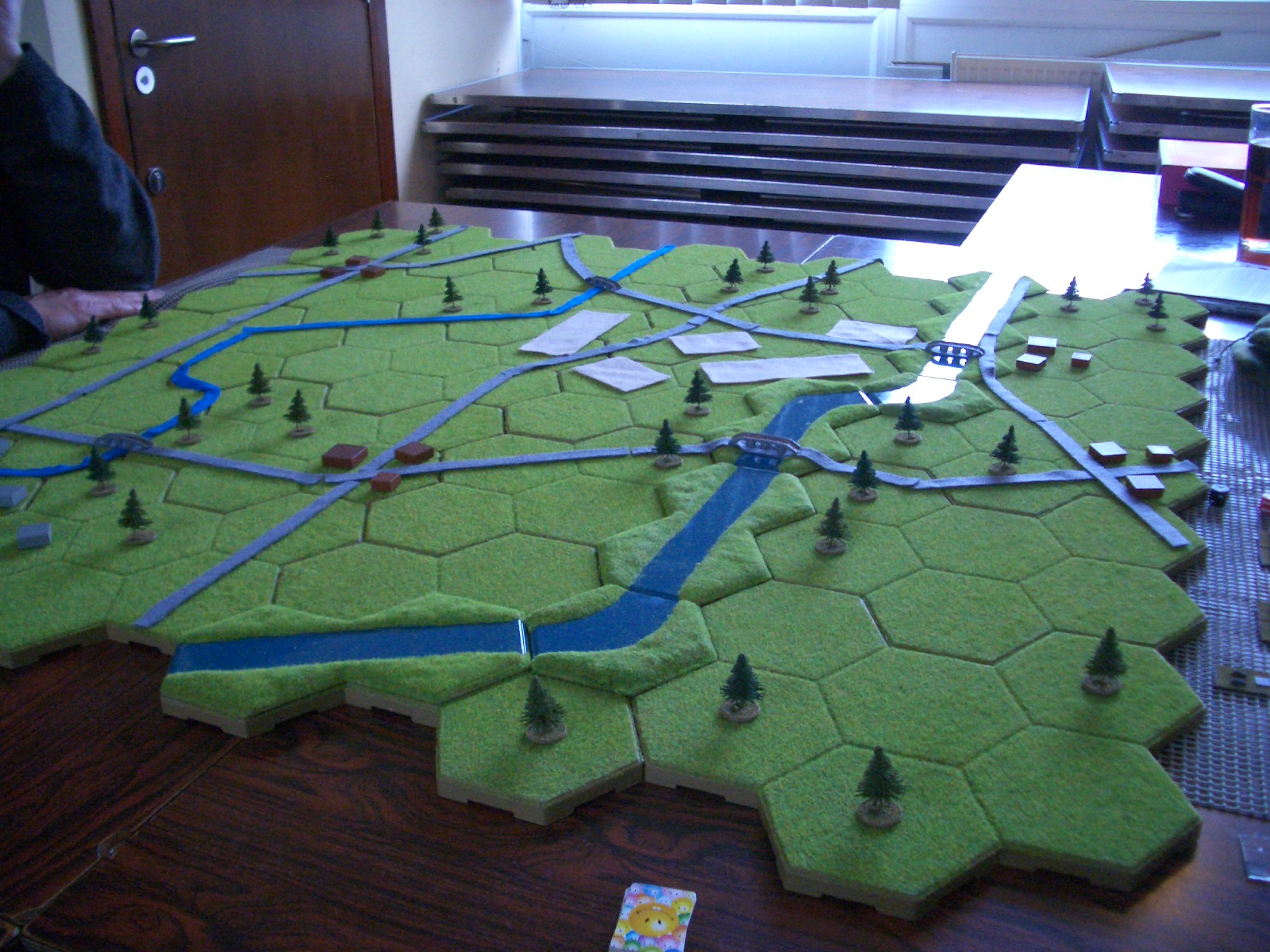
The area of operations from the SE.

BAOR battlegroups and TF assets line up.

61st GTR assembles.

Soviets advance behind a rocket barrage, the southern bridge is passable but unfortunately the northern one is heavily damaged.

Fitterburg is plastered with missile fire and set ablaze. Scimitars of the southern BG approach cautiously, northern BG can be seen in the distance.

Div forward detachment advances ot the southern bridge. The rest of the regiment masses at the northern bridge while the engineers effect hasty repairs. RHQ and AA company park up SW of GruBendorf.

Northern BG bypasses Wesendorf. The woods have been set on fire by missile strikes.

The leading tank battalions of 61st GTR advancing through the polder eye up northern BG across the Aller.

Sovs occupying a bridghead over the canal, the Scimitars have fallen back in disarry. Combat teams occupy Fitterburg.

Fire is exchanged in the south, some T64s are knocked out and the Soviets become disordered.

More firing in the north, more T64s go up in flames.

The first British assault on the bridghehead is repulsed, leaving several burning Chieftans behind.

Sovs hang on to their bridghead despite heavy losses. The air assault battalion is flown in to reinforce, but Rapiers shoot down half the battalion. RHQ arrives to sort out the mess.

Heavy exchanges of fire in the north. 'T64 wood' is packed with tanks as artillery fire rains down and one of the British combat teams suffers heavy losses.

The Soviet attack is halted in the north,  but the British will have to come and dig them out of their wood.

In the south the  main Soviet force falls back over the canal while a British combat team pushes up the road, observed by the recce troops.

This battle was one of those rare things, a meeting engagement, and I was interested to see how it would play out. The forces were fairly balanced, the Sovs with eight tank companies and four infantry vs NATO with four tank and six infantry companies respectively, the latter with an edge in troop and equipment quality.

As the narrative above indicates, the Soviet advance ground to a halt after crossing the first water obstacle and NATO was inflicting roughly a 3:1 loss ratio. Rather than play it out to the bitter end we extrapolated the  likely result as the entire Task Force pressed home its attack on 'T64 wood'. It seemed most probably that all Warpac elements west of the canal would be eliminated,  but at the expense of roughly 50% losses for Task Force Golf.

That effectively means the first echelon of 10th GTD has now been destroyed and NATO have retained control of the canal line in this sector, but TF Golf will need significant reorganisation and re-equipment overnight. A tactical victory for NATO then,  a reasonable return for their major effort here, but at the expense of leaving other areas of the front much weaker.

Saturday, 8 June 2013

Aggressive Delay (Part 1)

This scenario covers the next battle in my ongoing WW3 gone hot in 1981 series. The scenario title is taken from the expected posture of 4th Armoured Div, 'aggressive delay' in front of the rest of the BAOR. Lucky 4th AD! 10th GTD is now advancing on a single (reinforced) regimental front and has outrun its divisional artillery so fire support is provided by air strikes and the divisional FROG battalion. BAOR meanwhile has decided to make a major effort to eliminate this threat to the Mittelland-Elbe canal line, concentrating one task force on this sector while leaving the remaining 50km of front to TF Hotel.
 

Aggressive Delay, June 31st 1981


General Briefing
The rapid Warpac offensive has caught many NATO units still forming up although reinforcements have brought units up to their wartime strengths in many places. On the BAOR front, 10th Guards Tank Division has managed to push its leading regiment deep into the covering force in the marshy region north of Wolfsburg while the main body of 3rd Shock Army pushes up the autobahn to Braunschweig.

British briefing
4th AD is moving forward to engage the enemy spearheads, tasked with 'aggressive delay' to buy time for the rest of BAOR to deploy in their battle positions. Once the MLR is established, 4th AD will withdraw into reserve to reorganise. Ideally 4th AD will hold the enemy on the line of the Mittelland & Elbe-Seiten Canals, however this morning the enemy put in a strong tank attack north of Wolfsburg which risks unhinging the canal line.

It has been determined the enemy armoured spearhead must be halted and destroyed, and to this end the whole of Task Force Golf (4th AD) has been despatched to deal with it. The remainder of the division (TF Hotel) will continue on to Braunschweig. The RAF and Luftwaffe have put in a major effort to provide air cover for the operation and are also striking the rear communications of the enemy tank division.

Intercept and destroy the enemy armoured spearhead and establish a line on the canal.

Forces (D6, regular morale unless indicated otherwise)

Task Force Golf (4th Armoured Div)

TFHQ 1 x Mech HQ, 1 x Armoured engineer company, 1 x Rapier battery

Armoured Battlegroup                     Infantry Battlegroup

1 x GW troop (Swingfire)                   1 x mortar battery, 1 x Milan troop
4 x Chieftan Squadrons                      4 x Mech Infantry Companies (FV432)
1 x close recce troop (Scimitar)          1 x close recce troop (Scimitar)
1 x battery of Abbot in DS                  1 x battery of Abbot in DS


Cross attach tank and infantry companies between BGs and then break these down into two or three combat teams including BG level AT assets and (optionally) the mortars.


German Home Defence platoons or companies in some BUAs (D12, morale poor).

1 x regiment (3 x batteries) of M109 in General Support (one turn delay).

2 x Harriers and 2 x Lynx available for ground support. Close airfield.

Enter from the west edge on or adjacent to roads.


Warpac briefing

10th GTD has succeeded in pushing through the enemy light covering forces north of the Mittelland canal with minimal losses. The terrain is poor, march routes are restricted and coupled with demolitions and increasing numbers of NATO airstrikes the division is only able to put one regiment into its first echelon. The advance is vital as it offers the potential to outflank enemy defensive positions at Braunchsweig and the terrain further west is much more favourable for armoured operations. 62nd GTR has been reinforced and is leading the division forward. Enemy air activity in this sector has increased, and air recce indicates the movement of significant forces on our front. The bridges appear to be intact in this sector.


Push forward rapidly, bypass centres of enemy resistance which can be left to second echelon forces and continue to penetrate the enemy position.

Forestall the occupation of defensive positions, particularly along the Elbe canal and River Aller, and intercept and destroy enemy reserves moving to the front.


Forces (D8, regular morale unless indicated otherwise)

62nd GTR(+), 10th GTD, Cat I

RHQ: 1 x Mech HQ, 1 x recce Co, 2 x Engineer Co, 1 x AA Co
3 x Tank Bn (T64): 2 x tank Co ea
1 x Motor Rifle Bn (2 x BMP Co)
1 x SP Arty Bn (SP 122mm): 2 x SP 122, 1 x Btty HQ 
Div forward detachment: 1 x Tank Bn+ (T64): 2 x Tank Co, 1 x Amd engineer Co


2 x Mi 24 Hind, 2 x Su-17 Fitter at close airfield. Unlimited supply of Su-17s, but no more than two at a time.
1 x Air assault Bn (2 x para, 1 x Mi 8 helicopter), airlanding must be pre-planned

4 x pre-planned HE strikes by FROG (resolve as MLRS)


Enter on or adjacent to the main road leading in from the east in pre-combat formation, but don't need to be in road column. Recce Co can start in GruBendorf.


Terrain

Villages and towns provide cover (-1 to hit), woods provide concealment. Hills are not an obstacle, provide concealment to stationary units. Cultivated areas are bad going. The canal is impassable to all but amphibious vehicles (obstacle), the river is impassable to wheeled vehicles and an obstacle for other types.

Weather

The weather is good.


Umpires notes

Game length - until we get bored. Really it should be four hours (16 turns).


Airpower draw a card for each aircraft turn (if not on table)

Any red = Soviet move to ready, available from readiness.
Any black = RAF move to ready, available from readiness..
Planes need to be made ready before they can strike.
Once a strike is launched, planes return to airfield, need a card to rearm and move to readiness. They need another card to attack. SU-17s always attack when card comes up, others may choose to (auto available) and helos can loiter. Airborne attack is pre-planned.


Heimatschutzen are available at the rate of one company per three BUAs - probably two companies in Gifhorn.

Bridges may be damaged, D6, 1 = passable to dismounted troops, obstacle for light vehicles only, no tanks 2 = passable by light vehicles, obstacle for tanks, 3+ OK. May repair with one engineering action. Fordable river and amphibs at canal cross an obstacle (red card).

Area of Operations

The game table based the area NE of Gifhorn. The cultivated areas represent the polder next to the Elbe canal, passable but bad going.

Wednesday, 5 June 2013

Partisan June 2013

I attended the Partisan wargames show near Newark last weekend as part of Wargames Developments Display Team (north) and we ran Ten Rounds Rapid at the show. It was the twentieth anniversary of WDDT(N) running games at shows, so I hope this one did it justice. It was a beautiful day and the show was well attended. We had been moved from out usual spot as the hall interior had been reorganised and I was a bit anxious we were going to roast in the new location, but in fact it was pleasantly cool despite the blazing sun outside.

We ran the game eight times, including with a number of people who had actively sought us out. We took it in turns to run it so there was also time to get around the show. I cleverly managed to forget my camera, so took a few blurry photos on my  phone. Apologies for the picture quality.

John runs a game of Ten Rounds Rapid. Tumbling Dice stall in the background.

The WDDT(N) display board.

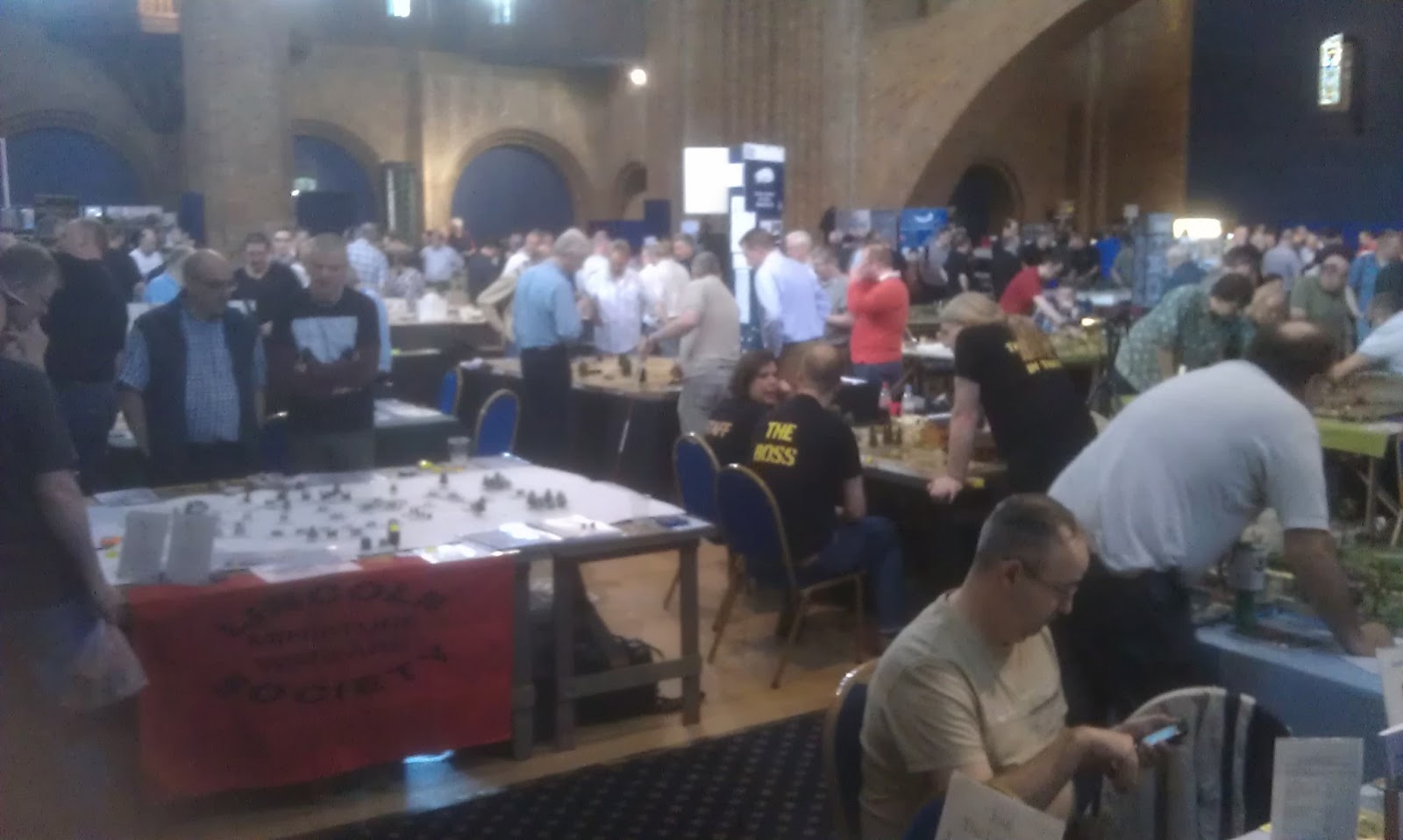
Press of people in one of the outer halls.

RAF Wargames Club running a Sci-Fi game.

SAGA

A huge Rapid Fire game set in France 1940.

German bombers.

One of the main halls.

George MacDonald Fraser inspired Bolt Action game in the Far East.

Wintery Napoleonics at odds with the weather outside!

The other main hall.

More winter scenery.

Lovely Kallistra hexon setup.

Korea

Large western desert game

The show was well attended but seemed less frenetic than Triples and it was nice to get a chance to chat to people and catch up with friends. My shopping was fairly minimal (stocked up on some steel paper) but I'm still sorting out all the stuff I bought at Triples. Nice to get back to Partisan after a break of a couple of years.

Saturday, 1 June 2013

20mm First World War Germans (Part 1)

I have done the odd post previously featuring my 20mm WW1 collection, so I thought it was time to meet the troops. Firstly mainly German infantry types of various kinds. The figures are all plastic, a mixture of Revell, Emhar and HaT.


Stormtroops advance supported by regular infantry and some heavy weapons.

HaT flamethrower team.

Emhar stormtrooper in gas mask, greatcoat and ammo bandoleers plus another flamethrower.

HaT granatenwerfers.

Revell and Emhar late war Germans.

The figures are all undercoated black and heavily drybrushed in a greyish field grey and highlighted in a very light drybrush of pure white. Some have a brown inkwash, some don't apart from weapons and flesh. They are all based on 30mm x 30m bases (my default for twentieth century figures) and have a mix of types such that they can be used for anything from 1 base = 1 section type games up to 1 base = 1 battalion. I generally use them for grand tactical or operational games, and although they are a bit big they work OK for OP14 on Kallistra hexes  (I usually just use two bases per brigade instead of four).