Sunday, 12 February 2012

Disaster in the snow

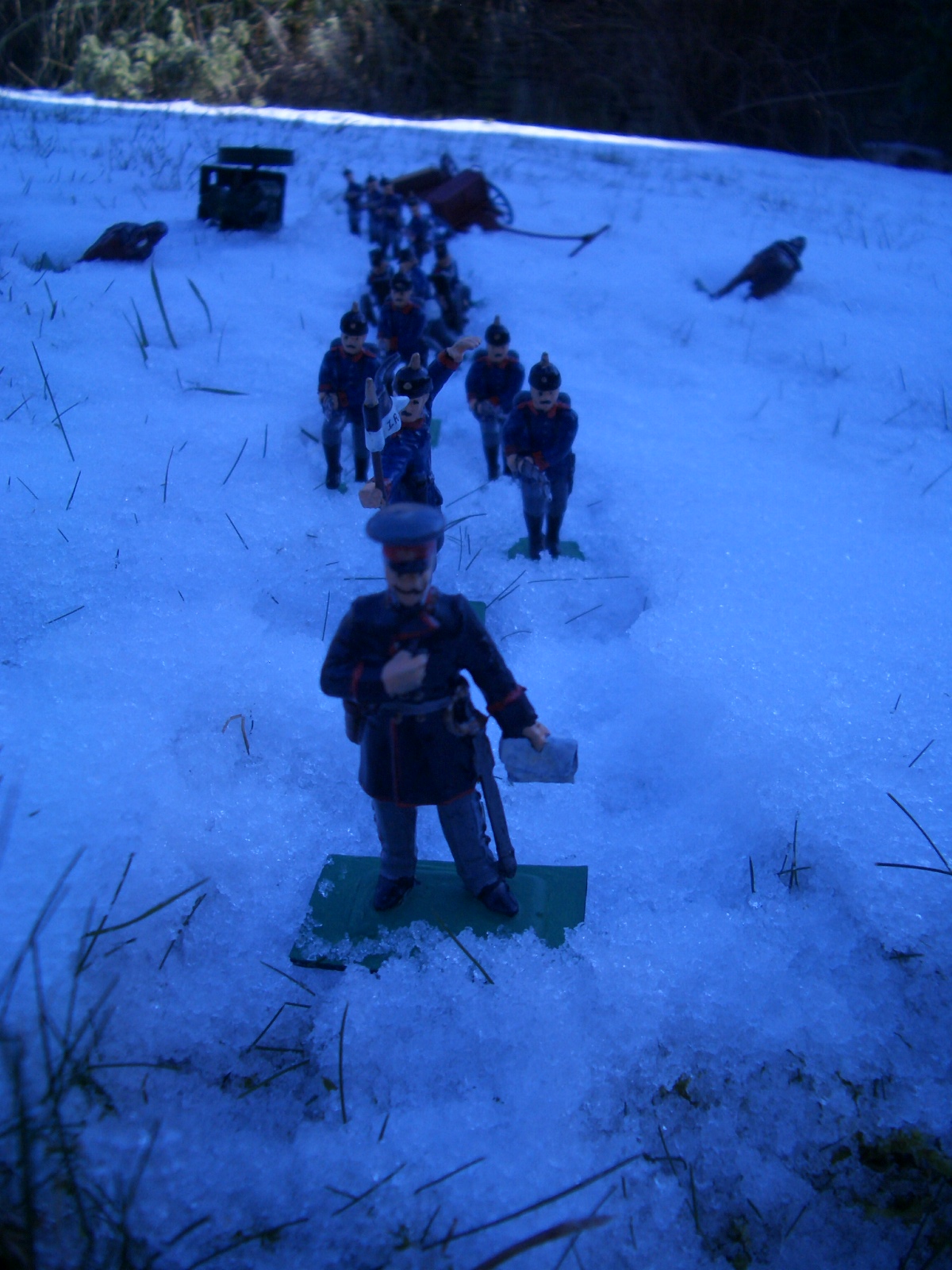
Tragic news from Vulgaria. As our forces returned from counter-terrorist operations in Forbodia, unseasonally heavy snowfalls seriously hampered the march. Logistics have always been a weak spot for the Vulgarians, and in the frozen wasteland the horses were unable to graze and supplies of fodder soon ran out, leaving the horses to starve in the snow.


Vulgarian officers on foot led the retreat through the frozen wastes.


Gunners manhandled the lighter pieces.

Limbers and heavy pieces were abandoned in the snow.

Jagers covered the withdrawal from positions in the snow.

Horses lay frozen in the snow.

Small groups of survivors stuggled on behind their standards.

 
It is to be hoped our forces make a safe and speedy return. At least the snow will impede Forbodian terrorists from crossing the border.

Thursday, 30 June 2011

Rasienie


This game was run at Sheffield Wargames Club in June 2011 and covered the Soviet counterattack on 6th Panzer Division at Rasienie in Lithuania in the opening days of Barbarossa.


6th Panzer Div recce battalion holds the river crossing.


Rifle Regiment around Rasienei.


Hordes of Soviet tanks! Some 250 of them in the real battle, lurking in the woods north of the river.


Soviet armour moves to attack the bridgehead behind an artillery barrage.


Soviets attack 6th recce Bn and cross the river to the north and south.


Things are looking a bit sticky for the recce troops.


Advanced tank units move to attack the Rifle Regiment.


6th Panzer Regiment races to the rescue while losses mount among the recce troops.


The German infantry start to waver.


Some Soviet tank units also start to falter, although some German infantry have been overrun.


The panzers engage the Soviet tanks while fighting rages around the bridge.


Heavy artillery and 88s arrive from the rear.


The recce battalion finally breaks and runs for cover, but the panzers continue to mop up.


The Soviet attack falters as the panzers start to cross the river.


The Soviet attack finally grinds to a halt. A result pretty much in line with the historical one.


Tuesday, 19 October 2010

Been a while....

Not doing very well with this blogging thing am I? Rest assured that I am still playing some games etc., just not getting around to writing about it.
Further to my last post about COW, I helped run a few sessions but also put on another big one of my own, in this case alos covering WW1, but simulating a Corps level trench warfare assault. Sadly there was some command and control confusion about when/where/if the session was actually taking place and I didn't have many punters. In the event the handful which turned up managed to come up with a brilliant plan:

Lots of boundaries, phase lines etc. It particularly helped that the wily Corps and divisonal commanders managed to obtain enough heavy artillery and ammunition to utterly flatten the German positions, although this completely tore up the already waterlogged ground.
Just to add insult to injury, the assault was preceded by a heavy gas attack along the entire front.


On the ground it ended up looking like this, as waves of British infantry pushed thruogh the shattered defences. Here the leading troops are passing through the German battlezone against scattered resistance from enemy reserves occupying strongpionts centered on villages to the rear.
To everyones astonishment the tanks lumbered right through to the end, making it as far as the German field artillery positions.
In other gaming news from July/August, we went on a family holiday to the USA. Along with swimming in the Pacific, driving across the desert, having an entertaining encounter with the US medical system via an emergency appendectomy in Las Vegas (seriously!) and riding the cable cars in San Francisco I managed to fit in a visit to a firing range in Nevada with daughter number 2. No restrictions on weapons in Nevada, so she got the 'Coalition Package' - M9, M16 and m249, whereas I went for a G3, M249 and a Sten.
G3 was fun to fire, very similar to an SLR (which I've already fired) and a very satisfying 7.62mm kick. Reasonable grouping and tore the target to shreds.
The M249 was a joy to shoot, really tight grouping, very stable and accurate, although I suspect the bipod and laser sight helped quite a bit.
Sten was....interesting. The range master was a bit nervous about it as he'd had an MP40 explode on him, but in the event it was fine. Very noisy, suprisingly high rate of fire and made nice big 9mm holes in the target. Main thing was it pulled up and left to an extreme degree so even with a three round burst the shots went all over the place. Once you'd got used to it, it was better and you could keep short bursts roughly in the same place. This was the gun I started with and I thought I was the worst shot in the world, but I was heartened to find some holes in the target from an adjacent lane, so at least I really wasn't the worst.
Worth the trip just for that I think.

Friday, 9 July 2010

COW 2010 - pt 1

What a great weekend, despite the sad and untimely death of Paddy Griffiths. A huge turnout and more games than it was possible to attend, I hope Paddy would have been proud of what he had started. To replace Paddys planned plenary game, I adapted my old participation game 'World War One in Three Turns' into a lawn game with real people, which at least kept the planned WW1 theme. People had made a real effort with making cardboard weapons and acquiring suitable hats etc and I'm glad that could all be put to good use.


Me in my 'Young Winston' (or maybe Middle Aged Winston) gear briefing the troops. Before coming outside the players were organised into twelve battalions, each with with own name and a set of 'cunning plans' to carry them through the next three years. Half a dozen Germans manned the enemy defences, according to pre set plans for each year. The game started on 1st July 1916. Oh dear.


Graham Evans leads a brigade in bayonet practice. Clearly the most sensible thing to do when faced with dug in machineguns behind barbed wire entanglements is to walk slowly towards them with rifles and bayonets. In each year of the war, the divisional CO (Wayne Thomas) was presented with a set of tactical options for the attack, and the battalions were committed according to pre set plans for each option. The fate of each battalion for each phase of the attack was determined by their cunning plans.


The sun sets on the field of glory. The attack in 1916 was a bit of a disaster, with only one battalion even making it into the German front line. 1917 went rather better, with some troops breaking into the second German line a few thousand yards in the enemy position. 1918 was crowned with glory however as infantry supported by massed tanks crashed right through the German defences to the green fields beyond.


Thanks to Tom for his excellent photos.

Sunday, 20 June 2010

Planning

We spent most of the gaming sesson at the club last week discussing stuff for COW (Conference of Wargamers, 1st weekend in July, held at Knuston Hall). In particular we were exercised by what hats and uniforms to wear for Paddy Griffiths 'Oh What a Lovely War' plenary game, I'm still holding out for 'Young Churchill' style pith helmets and Broomhandle Mausers. We also had a run through of one of Tim Gows new games he is taking, 'Tank Terror'. Don't want to spill the beans, but suffice it to say that it involves tanks.... It will also require special headgear for the umpiring team.

In other wargaming news, I've almost finished my first batch of 2mm WSS figures, some fourteen brigades of British troops, plus HQs, wagons, pontoon trains etc. Quite pleased with how they've come out, although I messed up the flocking on the cavalry, being to lazy to pre-paint the bases brown and now they've come out a bit too dark. I managed to retrieve the situation for the infantry and it is a lesson learned for the future. On to the Bavarians next, particularly looking forward to doing the cuirassiers.

I seem to be getting drawn in by the lure of WW2 re-enacting. A very expensive and time consuming hobby, as if I haven't got enough of those. Well, we shall see.

Thursday, 3 June 2010

A Surprise Encounter

Had a bit of a surprise last night, we seemed to end up refighting Borodino, which certainly wasn't on the game plan at all, just a happy set of coincidences. Tim emailed me asking what the plan was (I'd kind of assumed he was bring something!) but as I had managed to miss the WD Display Team (North) outing to Partisan I felt obliged to put something on. I've been busy painting my new 2mm WSS stuff, so I had Horse & Musket on my mind and rummaging through my file of scenarios I came across Sam Mustaphas Borodino scenario for Grand Armee. With the recent outings to 1914, I'd also got squares on the mind so I remembered my gridded carpet tiles, and then those 6mm Napoleonic Russians I'd got off John Armatys years ago and then the Leipzig rules which Baccus had used for their big participation game a couple of years back. All I had to do was transfer the Borodino map onto the squares (fairly easy as it was already gridded into 1k squares) and translate the OB into from brigades into divisions and job done.

Even at this reduced scale (one stand = 5000ish men) this is a BIG battle in a small area, with several Corps on both sides and the deployment areas absoutely stuffed with troops and guns. I went with Sams OOB but as I was running out of Generals, I assigned some of the Russian cavalry corps in direct support of various infantry corps (as was done historically) and gave the French the option of attaching out Murats four corps of cavalry or leaving them as one huge cavalry wing. The French opted for the latter.

Tim took a series of photos through the game, which hopefully I'll be able to post when he sends them to me, but the main course of events was as follows.

Both sides deployed broadly historically, but Murats cavalry massed on the French left wing. The French didn't like the look of the Russian centre at all with is massed 12pdr batteries, so proceeded to attack both Russian wings. On the left, Murats cavalry rode forward against the Russian IInd Corps, the main forces supported by Cossacks and various Italian infantry respectively. The Neapolitan grenadiers surged forward to suport Murats right flank. On the right, Davout and Poniatowski attacked the Russian left. The Russian left proved fairly sturdy and it required the commitment of the Old Guard to finally break them, but not before Davouts Corps had exhausted itself.

On the right Murat and the Italians finally overcame the Cossacks and IInd Corps, but at the expense of grievous losses. The Russian Guard had moved up to support IInd Corps, and in a final dash for glory, Murat led all four cavalry corps in line abreast against the Guard grenadiers. The Russians repulsed the attack and the French cavalry fell back exhausted. The Russians then counterattacked Borodino itself and drove the Italians back in disarray.

On the Russian left, more Grenadiers supported by heavy artillery attempted to hold off the Poles and Imperial Guard as the Russian Guard counterattacked in the centre, driving off both Neys Corps and the Westphalians as their left wing crumbled.

As night fell the only units left with any offensive capability were the Russian Guards and VI Corps, the Poles and the Imperial Guard. Real wargamers armies! The Imperial Guard and the Poles launched a final assault against the Guardsmen holding the redoubts in the centre, the Poles siezing the moment of glory as they advanced through withering cannon fire and turned the Russian Guards left flank, forcing them back. Both armies lay exhausted amongst the indescribable carnage, but the way lay open for the French to resume their advance. Unlike the historical result, in this case the Imperial Guard had been decimated. Phew.

This turned out to be a really good game, very intense, a surprising amount of manouvre given the constricted battlefield and with plenty of decision making and swings of fortune. Kutusov in particular kept falling asleep at the wrong times, and even the mighty Bonaparte seemed to have trouble keeping control of his concentric attacks on both wings - I suggested that with his little legs he couldn't see what was going on. Maybe it just goes to show you don't need to spend weeks preparing a game to have a good time. One very amusing aspect was the way the John 'Napoleon' Armatys kept referring to the the Russians as 'The French', shades of the Crimea there.

In other gaming news, I'm plodding on painting the 2mm WSS stuff I bought at Triples. I've started with the British (well, who wouldn't?) and the techniques I used on the sample figures seem to work OK en masse. My sequence of doing flesh then hats is slightly cumbersome, but I'll see how I get on as the alternatvie is ot do the faces after I've done the hats, and I can see paint going all over the place unless my hands are rock steady. 2mm faces aren't very big to paint, but really add to the look of the figures. Once the British are done, I'll move onto the Bavarians for a change. The curiassiers will be an interesting challenge, I might go with silver breastplates rather than black ones, have to see what looks best.

I've also been inspired by the WW1 operational games and looking at working up some 1914 and 1918 scenarios, the 'Great War' TV series on DVD has been particularly interesting for the latter. Really I want to do a scenario which will involve Whippets and cavalry, as my Whippets have never seen action before.
Thursday, 20 May 2010

More WW1

TimGow put on another game last night using Ricahrd Brooks 'OP-14' operational WW1 rules. A rather larger affair than last time, The Battle of Gumbingen, with three Russian Corps vs one German Corps (rising to three and a half German Corps plus a cavalry division).

I took the Russians, and having actually read the rules had slightly more idea what I was doing this time, in particular using reserves to keep the firing lines up to strength. The Russian steamroller rolled forward, and managed to bludgeon its way into Gumbingen, smashing one German Corps in the process. The Germans were somewhat handicapped by splitting their small force, the detached elements being then crippled by being out of command which allowed the Russians to concentrate the best part of two Corps against one division with predictable results. One Russian brigade in particular distinguished itself by drawing mandatory attack cards, but rather than being shot down in heaps, it drove almost unaided up to and then past the town.

By mid afternoon the Russianshad pretty much shot their bolt however, and although one Corps was strongly dug in around Goldap, the other two were overstretched with one already exhausted and the other well on the way. Fresh Prussian troops were counterattacking strongly and it looked like a withdrawal at nightfall would be in order.

I thought the game looked pretty good and flowed well. It was particularly pleasing how the firing lines solidified into strange angles and re-entrants, looking very much like the unit fronts in battle maps of the period.

Looking forward to the next outing.