I finally developed an Eylau scenario I was happy with - it is largely based on the one in the 'Bloody Big Napoleonic Battles' scenario book and only covers the second day of the battle. I'd originally hoped to do the battle for the town the previous day but I can understand why they just went with the main event. At least the scenario had something approaching a reasonable OOB and a map, although they had chosen not to include any of the streams as they were covered in snow!
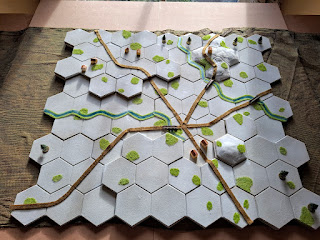
Battlefield from the south. Eylau is the town near the main road junction in the centre, Konigsberg is up the road off to the north west. I included the streams just for the look of it, I had to refer to the maps in David Chandler for those. The NBBB scenario has seven objective villages, I consolidated them down to four - Eylau and L-R, Schloditten, Anklappen and Serpallen on the ridge to the northeast. Whoever controlled most by the end of the game would win. The Russians start controlling three, so the onus of attack is on the French.
The larger areas of high ground I modelled using extra hex tiles, but 'Napoleons Ridge' above Eylau I added as an extra hill on top. The streams have no effect (frozen), but the roads are in effect and I added in the wooded areas from Chandler as they are also missing from NBBB.
The Russians start with almost their entire Army deployed, having fallen back to the high ground across the valley after fighting Napoleon for the road junction at Eylau the previous day.
In the centre are the reserve cavalry, six infantry divisions and one grand battery. I didn't bother with Bennigsen, but I included Dokhturov and Kamenskie as Leaders. The NBBB scenario rates all the French infantry as better than the Russian, but instead I used a slightly more generous force multiplier for the French units .
On the right is Osterman-Tolstoy with two divisions, one of which is configured as a Grand Battery. The Russians had twice as many guns as the French, so get two artillery units. About half the total guns are assumed to be allocated to the other infantry units, and the 'grand batteries' also contain about half as many infantry as the normal ones.
The French, in contrast, have major bits of their army missing! The only units actually on table are Soults 4th Corps, Augerau's 7th Corps, Murats Reserve Cavalry and the Imperial Guard. Although the French are quite concentrated, the Russians outnumber them. Not great as they have to attack. Murat and Soult are included as Leaders, while Napoleon is hanging around to direct things.
Hurrying to the rescue from the east is Davouts 3rd Corps. 2 x infantry and another leader.
And from the west is Neys 6th Corps. Also 2 x infantry and a leader. However marching in front of them is Lestocqs Prussian Corps.
All the reinforcements have an arrival schedule, Davout is due on turn 1, Lestocq on turn 6 followed by Ney on turn 7. However the battle was characterised by appalling weather, so the reinforcements may be delayed...
I didn't want to overdo the weather, but it was very variable on the day and had a major impact on operations. Essentially each turn there was a weather roll 1 - blizzard, 2 - heavy snow, 3/4 - light snow, 5/6 - clear. Blizzards and heavy snow seriously restricted movement and visibility and delayed reinforcements, light snow just restricted visibility and clear was clear.
Naturally on turn 1 I rolled 'heavy snow' - so reinforcements were delayed, movement restricted to a maximum of 2 hexes and visibility was 1 hex. Bad news for Davout.
Napoleon used the cover of the snow to shuffle some units around. Soult rather bravely marched into the valley to set up for some shooting next turn. Very brave indeed as he was outnumbered 2:1 by the Russians on the other side! Augerau moved down from Napoleons Ridge to support Davouts eventual attack on Serpallen on the French right.
The Russians also did some shuffling in the snowstorm, moving the artillery into a better location and closing up the reserve cavalry slightly to discourage too much French light infantry action. For now, though, they could just defend.
The snow eventually lifted sufficiently for visibility and mobiity to improve a bit. Soult engaged the Russian left wing with artillery and skirmishers, while Davout turned up on the right, linked up with Augereau and engaged Tolstoy on the isolated ridge. The snow was still too heavy for the Grand Batteries to engage at long range.
On the right, the French concentrated their fire on the Russian guns on the forward slope. Eventually they were weakened enough that Davout sent a unit forward in open order.
Soult also advanced on the left. I'm trying out Gary Sheffields tweaks to the morale rules - essentially you roll against hits suffered to advance against the enemy, and Gary has added a provisio that units also have to test to stand. Dokhturovs division was fairly battered but faced with Soults advance they stood.
Soult suffered heavy losses from Russian fire (three hits!), but Murat led his cuirassier corps against Dokhturov and routed the Russians. Dokhturov survived and retired to the adjacent division, while Murat crested the ridge.
Back on the right, Davout and Augerau settled down to more pounding in light snow.
Murat judged the Russians sufficiently weakened and the other cavalry corps charged the Russian guns and took them!
Murat slightly regretted charging into the middle of the Russian position. The entire Russian line opened fire, chipping another hit off Soult. The Russian cavalry charged Murat behind infantry volleys, and the cuirassiers was lucky to survive with five hits. I've only rated the Russian cavalry as medium as they had so many Cossacks in this battle.
I'd intended to deploy some light cavalry stands to act as ZOC, but I completely forgot and also completely forgot about ZOCs too, which proved to be an issue later on.
Rather than lose the cuirassiers, Murat withdrew to reorganise. Soult pulled back behind the stream and out of range of the Russian infantry divisions. On the right, Davout pressed up hard against Serpallen, the Russians having retired there after losing their guns.
I'd set up the other French cavalry to cover Soult (they are in front of the grand battery on Napoleons Ridge), but seeing the cuirassiers withdraw and being in range of Soult carrying four hits, the Russians just had to keep on and their cavalry charged the French infantry across the frozen stream.
The Russians were hiedously unlucky and just scored 1 hit, although in fairness they would have needed three hits to rout the French. They are now left hanging out to dry in front of three French infantry units (those are the Imperial Guard across the bridge on the right).
Davout sends in two divisions in open order to attack Serpallen. His close order division reorganises and is left with two permanent hits. I'll keep that in reserve to storm the village.
Soult reorganises his battered division which acquires three permanent hits. Rallying so close to the enemy involves considerable risk, which is why five hits rounded up to three casualty markers, but Soult doesn't roll a 1 and survives. The other French infantry shoot up the Russian cavalry, and Murats heavy cavalry corps charges.
The Russians cavalry survives with heavy losses and retreats to Schloditten to reorg accompanied by Gen Kamenskie. The Russian infantry shoot up the French where they can, but Dokhturov shuffles another division across to line the ridge and prevent a french cavalry pursuit. Of course they didn't need to do this as there are ZOCs to stop this sort of silliness, but I forgot.
The Russians despatch their last reserves to Serpallen. An infantry division and the other cavalry corps, which charges the French infantry who are deployed in open order on the ridge. The ridge disadvantages the cavalry, but they are still good against open order infantry. The village garrison softens the French up with massed volleys.
And the Russian cavalry carry the ridge, the French infantry flee in disorder and are cut down. Oh dear, bad news for Davout.
However the French return the favour. Davouts close order division pours withering fire into the Russian horsemen, the Imperial Guard artillery opens fire into their flank and Murat follows up with another charge by his battered cuirassiers which sends the Russian horse from the field and leaves them adjacent to the Russian infantry in the open.
However back on the left, the reorganised Russian cavalry under Kamenskie make another charge in Soult, and this time the battered French infantry are routed although Soult survives. The French left is now looking in dire peril, if only Ney would arrive!
Instead Lestocq's Prussians finally arrive and set up to cover the extreme left flank (they are just north of the stream). I rated the Prussians as 'poor' for this as their Corps was quite weak and the Prussian army had been completely outclassed earlier in the campaign.
Over at Serpallen, the entire French reserve cavalry under Murat charge the Russians in the valley and inflict enough hits to rout them. The French are going all-out to take the village and secure a draw. This also puts Murat on the flank of the Russian grand battery.
The Russians throw in their other cavalry corps and Murats cuirassiers have finally had enough. Murat is seriously wounded and carried from the field. The Russians are exposed to a counter charge but it was worth it to finish off the cuirassiers.
The rampaging Russian cavalry are now deep into the French left rear. Napoleon is forced to relocate the grand battery off the ridge to prevent them simply riding into Eylau. Ney has now arrived however, much to Soults relief and the French form a sort of hedgehog south of the stream. The French army is cut in half, however heavy snow shields them from the Russian guns on the heights.
The French along the stream start trading shots with Lestocq as Neys other division forms back into close order. The French gunners position their guns to fire into he flank of the Russian cavalry. Time for them to go home I think. Dokhturov lines the ridge with infantry again.
Supported by the Imperial Guard, the last French cavalry rout the Russian horsemen. Once again this exposes the Russian gun line, but Serpallen still holds out.
In light snow the Russian cavalry make their escape across the stream. Lestocq manages to rout one of Neys divisions in close quarter fighting! Soult is still hanging on but things are not going well for the French here, however without immediate infantry support, the Russian gunners limber up and head back into Anklappen. They can't fire from here but they can occupy the village and stop the French cavalry riding into it.
Heavy snow brings everything to a grinding halt. I rolled a disproportionate number of snow turns in this game. The Russian cavalry are crushed between the grand battery and the last French cavalry unit and Serpallen finally falls. The entire Russian line swings back and forms up along the line of Schottingden and Anklappen. The Imperial Guard marches up the Koenigsberg Road and Soult crosses the stream as Ney finally routs Lestocq but the whole battle is moving in slow motion as visbility and movement are so restricted.
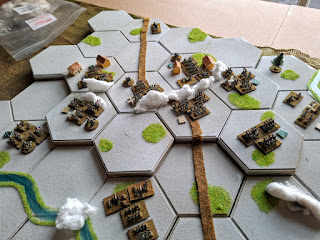
In the last couple of turns the French manage to push some units up onto the plateau, but time is very short. In the end not even the Imperial Guard can dislodge the defenders, although there was a very exciting morale test as Davout moved up to Anklappen. The defenders had four hits, so a roll of three of less would see them withdraw under normal circumstances, however they were bolstered by General Osterman-Tolstoy who had survived the fall of Serpallen. +1 for a General +1 for being in hard cover, so anything but a 1. The Russians rolled a 3, and the game ended as a draw with both sides holding two towns.
Napoleon surveys the scene from Napoleons Ridge, although the three big smoke puffs indicate this is a heavy snow turn so he'll be lucky to see any further than the nice warm inn in Eylau.
That went very well and produced a historical result, which is always pleasing. With better weather (there was only a single clear turn in the entire game when on average there should have been five) they may have been able to batter their way to victory, or maybe not. If I was running it again I'd restrict the number of delays to reinforcements to a maximum of two, they are marching on roads after all. I might also drive the weather with cards instead of dice, as cards have memory which dice don't.
Garys suggested morale changes certainly added to the tension and tactical decisions, I repeatedly tried to wear units down and then advance a fresh unit adjacent to force a 'stand' test but both sides passed every single one! Units need to be quite battered to fail morale and are generally fairly close to destruction in any casie, so it may be an unnecessary complication. One thing I may experiment with is having adjacent infantry units roll each turn to stand, which makes it slightly more likely battered or unlucky units will retire instead of fighting until they disintegrate. The rally/reorganise rules worked well though and I'll keep that as a mechanism, converting half the recovered losses into permanent hits stops the game grinding to a halt.