Thursday, 24 December 2015

Combat 330

Some years ago I played Ian Drury's 'Combat 300' at COW, that particular game being a brigade level western desert game, 'The Defence of the Knuston Box'. I was rather taken with the game system, and have variously tinkered with it over the years with a view to battalion/brigade level WW2 games. The original rather showed its heritage from the Minschlacht/Red Square/NBC/OP14 series of games with card activation for each element, and differing dice to differentiate quality. Some elements of those mechanisms can be bit cumbersome for larger games, and even for smaller club night games. Both Ian and I have, in parallel, been working on some streamlining of the systems, and although some of the mods are similar, in other cases we have gone in different directions, so I christened my version Combat 330, as 330 yards is roughly the same as the 300 metre hexes in Ians game.

I'd playtested it at home a few times, and for its first outing at the club I pulled out my old 'Castiglioni' scenario - a British battalion assault on a German blocking position on a road to Rome following the fall of Monte Cassino. Historically it was a US infantry battalion attacking,  but I don't have 15mm US troops. The players (John, Tim and Jerry) took the British and I ran the German defenders. Units are infantry companies or tank/artillery platoons/batteries, with various types of support platoon around. 330 yard hexes and 15 minute turns. Recce troop has reported the road ahead to be mined and covered with mortar fire, so the plucky South Essex have been sent to clear the way.

View from the German side. The wicked Germans have hidden themselves well. Minefield dimly visible on the road in the defile. This game was also the first outing of my hexon fields (made up on plastic templates) and the new stream sections I'd made.


Air recce buzzed the town and spotted signs of entrenchments, in particular what looked like a mortar position to the rear of the town, and possible AT guns amongst the buildings.


Two British rifle companies went left flanking to link up with carrier section from the recce troop, accompanied by a troop of Shermans. The stream did not prove to be much of an obstacle.


Later in the game, the town is fairly thoroughly enveloped from both sides. The British left flank has bogged down in a prolonged firefight, but on the right the German defences have been pulverised by a regimental 25pdr shoot.

The German left flank is overrun by a rifle company supported by the carrier platoon. On the German right the Allies gradually gained fire superiority.


The German defences collapse and the survivors stream to the rear. In the end about half the Germans got away, including their mortars and AT guns (which had pulled back earlier) and the many of the remainder surrendered. The British casualties were fairly light, although one company was rendered ineffective by losses.

All in all it was quite a successful playtest, got through 16 turns (four hours irl) in an hour and a half. Most of the mechanisms worked OK, but the game highlighted some areas where things creaked or were unclear or were too complex to remember so it still needs a few tweaks. Hopefully be back in the New Year as I have a mini-campaign in mind, but I think it needs another decent playtest first before embarking on that.


Saturday, 24 October 2015

Reclaimed hoplites

This week I have mostly been recovering from last weekends shenanigans and sorting out the stuff for my forthcoming 100th Anniversary Loos game. I did however come across some photos of yet more figures recycled form other peoples collections.These are Hoplites from the collection of the late Robert Plumb. 

Metal figures, no idea of the manufacturers, and which required very little tarting up.

Assembled hoplites.
As usual, I put them on my 60x20 25mm DBx bases, and managed to assemble/repair enough of them for five elements. A few of the figures were in a sorry state with missing bits and needed a moderate amount of work.

Cloaked hoplites.
This batch all seemed to be identical castings, with small plumes and big cloaks.

Odds and sods.
These were more of a mixed bag, with various styles of figure which I had to mix up on the bases.

The lonely ones
This bunch were also similar and made up an element on their own, although a couple of the spears needed replacing.

Slingers, you can never have too many.
These venerable figures came via Mr Gow, and are I believe from the collection of his late friend JR.

The paintjobs on all these figures were pretty good, all I did was give them an ink wash and highlight some details after repairing the broken bits. I am sure they will give sterling service in the years to come, and I hope their original owners would have been glad to see them going on being used.

Finally....
Baa!
These goats have been in my painting box as long as I can remember. They are 20mm Irregular, and I think I originally got them to to a DBx camp element. As I was fixing up the hoplites and slingers, I took the opportunity to finish these off too and did them as single based so they can be scattered around in a scenic manner. Like the slingers and hoplites above, I am sure you can never have too many goats. There are a few other interesting things in my painting box, including a maxim gun mounted on a mule. Well, maybe one day....


Sunday, 18 October 2015

Operation Iskra

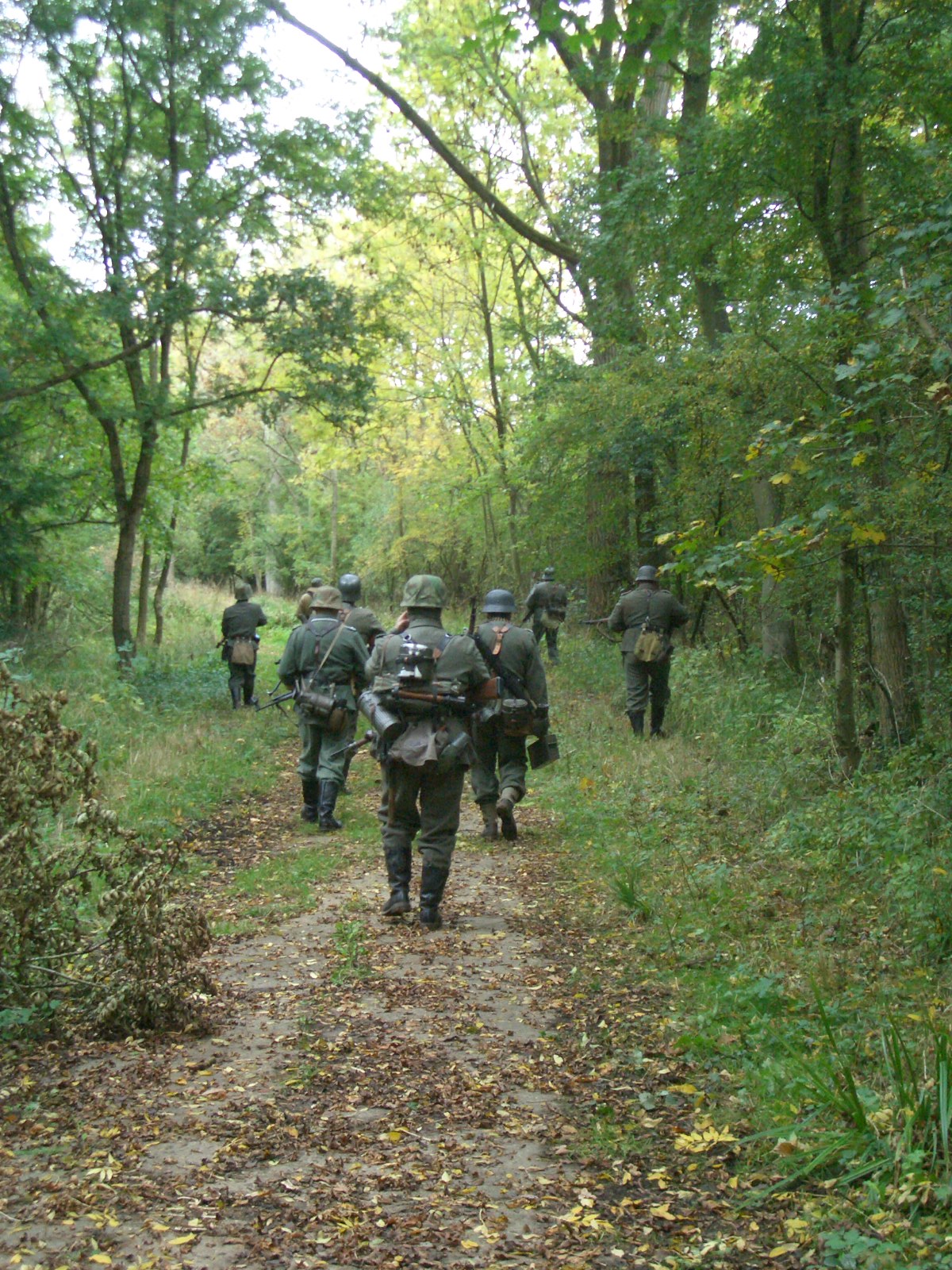
This weekend I've been dressing up and wandering around the woods, as I do from time to time. This particular outing was a trip to the Siege of Leningrad in early 1943, which was played at the excellent Close Action site at Grafton Underwood (an ex USAAF airbase, now heavily overgrown). I helped organise and run it, but apart from laying out the props, the game largely ran itself and all we had to do was avoid getting lost and  keep the mission timings on track.

Milling around in the car park.

The Red Army moves out.

German infantry cautiously move up the tracks.

Enemy ahead, possibly.

Advancing across the cornfields. Well it is Russia...

Commanders relaxed before the next Russian onslaught.

The mighty 75mm infantry gun in action as a Soviet prisoner looks on.

Tired Germans slumping in the afternoon.
This was the third game organised by the 900 Days group. We aim to put at least one game on a year, and they are all set on the Eastern Front around Leningrad, so people who have invested in Russian kit get a chance to use it. If you fancy having a go just sign on the  WW2 Airsoft Forum, and we've got kit to lend out for people who haven;t got any Russian gear.There is also a Facebook group, imaginatively called The 900 days.

Saturday, 10 October 2015

2mm ECW

A period I have been interested in, yet never taken the plunge, is the English Civil War. Mainly the same reasons as it took me 30 years to finally do WSS, I was never interested enough to do serious uniform research for larger scale figures. However, a chance purchase from Mr Gow of some 2mm pike blocks got me thinking. I already had a load of 2mm WSS foot and horse, and in this scale no-one could actually tell what uniforms the units are wearing, so coupled with a few more pike blocks.....


The resulting mayhem.


The elements I had were supplemented with a few/several/quite a few extra pike blocks from Irregular (and some more horse and guns, well you can never have too many can you?). Sorting out the proportions of various types was fairly easy as once more Neil Thomas had ridden to the rescue with an eminently approachable set of pike & shot rules, coupled with vast army lists. Just to be on the safe side I sorted out enough stuff to do not only the ECW, but also the Thirty Years War (also a long abiding interest) and the oft neglected Franco-Spanish War.

I based all the elements the same as my existing WSS figures, on 30x15mm bases with multiple strips of foot, horse or guns. Some elements (like Tercios and some very big pike blocks) I put on 30x30 to use as double size bases. As Neil Thomas's units have six bases (twelve for Tercios and TYW units), I also made up a load of magnetic movement trays in various denominations as the tiny elements are so fiddly to move otherwise.

For a scenario I chose Edgehill and took the terrain, OB and deployment from Richard Brook's excellent 'Battlefields of Britain'.

A some what blurry shot of Edgehill. The lower slopes are on the right, tributary of the river Dene at the top. Parliament on the left, the Kings Army on the right. Rupert is leading the Royalist horse forward at the very top, and at the bottom, Parlimentary horse have driven back their opposite numbers. The infantry centre is engaged in musketry.
Push of Pike in the centre. The Royalists have suffered brutally from the more effective Parliamentary musketry.
 The game was run at the Sheffield club, the overall battlefield was 80cm x 80cm (I reduced the suggested ground scale slightly as I use 30mm wide bases, not 40mm) and the armies broadly used the historical deployment although Parliament decided that their left flank was a lost cause against Rupert, so reinforced the horse on their right.


Deciding moment of the game, the weakened Parliamentary horse manages a spectacular saving throw!


The battle folowed the broadly historical course,much to my delight. The centre engaged in a dour slugging match, with parliament gaining the upper hand due to their superior equipment, however Rupert routed the Parlament left, and promptly left the battlefield to loot the baggage! This prompted half the Parliamentary centre to head for the hills, and suddenly things looked a bit brighter for the struggling Royalist pikemen. However over on the right, the parliamentary horse won a spectacular victory over their Royalist counterparts despite being completely outmatched, and in turn they overran the Royalist artillery and also headed for the baggage. The weakened Royalist centre broke, leaving both sides utterly exhausted and with an honourable draw.

I was really rather pleased with how it went. The toys were a bit fiddly, but the movement trays helped a great deal, and the rules (which looked a bit dubious at first) produced an exciting and fast moving game which was over by a thoroughly civilised 9pm. Neil Thomas triumphs again! I wish I had his rule writing skill. For the next outing I'd like to try the Thirty Years War, but although I studied it at school and University, my memory is hazy and I'll need to do a bit of reading. Which is lucky, as I've just bought 'Europes Tragedy' by Peter Wilson.


Sunday, 27 September 2015

Simulating War

I recently re-read 'Simulating War' by Professor Phil Sabin. It is a couple of years since I last read it, and it was interesting how much more I got from it this time.


The first time I read it, it was largely a matter of confirming my own prejudices about how badly many/most/all wargames rules model the realities of twentieth century land warfare, in particular the fallacy of the Lanchester square law which holds that combat power and losses are a square (and inverse square) of force ratios.   This is demonstrably not the case in even the most trivial of real life examples, as otherwise simply throwing more bodies and tanks into the fray would be the solution to every tactical problem.

Anyway, I digress. This time around, one of the main things I got from it was a better understanding of the difference between  wargames as command simulators and as a mechanism to explore a historical narrative of events. In the former case, quite different mechanisms need to be involved, generally modelling various degrees of friction and fog of war (and all those mechanisms like cards or hidden movement which wargamers love or hate) whereas for the latter, a much more open approach is possible and generally much closer to traditional open wargames with high levels of knowledge. Trying to both at once has the potential to cause great confusion, and may explain many of my abortive attempts to come up with 'perfect' sets of rules.

Such thoughts did set me thinking abut how the general approach in Phils 'Korsun Pocket' game could actually be applied as more generic operational Eastern Front set of rules, with the grandiose scale of the stands representing entire Divisions and Corps - a step up from my own Panzergruppe rules. Re-reading David Glantz's 'From the Don to the Dneipr' produced lots of examples where the combat model and scale of representation fitted rather well.  Anyway, various half baked ideas emerged over the summer, so that one is a work in progress.

It also got me thinking about my favourite WW2 level, brigade level games with platoon(ish) sized stands. My last outing in this arena was a bit of a disaster, too much stuff with mechanisms which were too slow. Inspiration has once more struck, so again, a work in progress there.

In the meantime I have been doing some painting, and interesting foray into 2mm Pike and Shot thanks to an impulse buy from Mr Gow at Triples, as well as finally painting the 15mm Early WW2 Germans I got last year. I have also been very gratified to find people like my One Hour Wargame rule variants, so I seem to be on the right track with some of this stuff at least.

Friday, 21 August 2015

One Hour Wargames variants


I am quite a fan of Neil Thomas's rules, in particular his One Hour Wargames, which include not only sets of rules covering everything from Ancients to moderns, but also 30 scenarios, and army generator etc. The rules are so simple it is easy enough to tweak them and bolt bits on, although one much be careful not to completely obliterate the original mechanisms.

I've put a few variants up on the AMNW yahoo group, but following Bobs kind remarks about the WW2 version his blog One Hour WW2 AAR I've put the WW2 variant up here too on the downloads page.

Direct link here One Hour WW2 rules (hex) it is a good idea to have the rulebook too so you've got the scenarios etc.

I've also added the WW2 naval rules referenced in my COW report (look for Mini-Jutland) report, again direct link here:  One Hour WW2 Naval


Sunday, 9 August 2015

Operation Charnwood (1)

At something of a loose end one week I decided the time was ripe to plug on with our Memoir 44 Normandy Campaign. Avid readers may recall that the Battle for Hill 112 all went a bit pear shaped for the Germans at the last minute despite some early successes, so Monty is now in a position to press on to Caen from the north a bit earlier than historically.

The Operation Charnwood mini-campaign only has three battles, and consists of the Canadian Corps attacking Caen on the north bank of the Orne after a massive RAF bombardment. The city is defended by the elements of 12th SS Panzer Div and 16th Luftwaffe Field Div. Historically, although in theory three Allied divisions supported by three entire armoured brigades attacked, in practice they only committed a brigade or two each, who in turn only committed a battalion or two...

As always, this was played on Hexon terrain  using my 15mm toys with my Memoir 45 modifications. All the tanks and halftracks used in this scenario were plastic PSC ones. Memoir 45 is available from the downloads page.

The battlefield from the German side.
John took the Allies and Jerry the Germans. The Germans were dug in with a fair number of wire and entrenchment markers and lots of buildings. The RAF bombing had however blown a huge hole in the middle of the fixed defences, although German armour and panzergrenadiers were in evidence in depth behind the hole.

Shermans and some infantry pushed into the gap.

German defensive fire inflicts some losses and pushes back one of the Shermans.

Undeterred the Allies press forward in an 'armoured assault'

The Germans promptly counterattack with the same card and it all gets very messy!

The battle continues to rage.

The panzergrenadiers pitch up to help as British infantry assault the trenches.

Although some of the fixed defences are cleared, sadly even the intervention of RAF Typhoons is not sufficient.

So a fairly resounding victory for the Germans in holding off the initial assault. As so often seems to happen in Memoir 44, the action was mainly resolved by an armoured slugging match, although the Allied tanks in particular were almost completely ineffective against the German infantry dug in amongst buildings. Both sides had 'armoured assault' cards which was almost certainly going to provoke a big tank battle, although the Germans showed great restraint in holding their armour back while the fixed defences took their toll of the allied attacks.

Despite this being a pretty fast and furious game, I am still pleased with the Memoir 45 modifications. They seem to produce a more satisfactory game inline with later CnC games in the series but without the vast raft of special unit types bolted on to the original Memoir 44 game.

So, on to the  next battle in the series. Despite their success, the Germans have been ordered by Army Group B to conduct a fighting withdrawal cross the Orne, which will be interesting.