Saturday, 17 February 2018

The Tsars Legions

Regular readers may recall I had a slight eBay accident last year, as my search for some WW1 15mm Russian figures that I didn't have to paint myself yielded instead a 15mm WW1 French Army...C'est magnifique. Although I don't usually let myself be distracted by impulse buys, that one worked out OK in the end.

Anway, after Xmas I decided I was in need of a new years sales wargames treat, so resumed my search for Russians once more. This time it turned up a ton of suitable stuff which was duly assessed and ordered (I was aiming for enough figures for two Infantry Corps and two cavalry divisions for OP14).


After rebasing the lot, I ended up with a fair bit of kit and few spares left over. Some of the figures needed some TLC, especially the cavalry which by and large I had to completely repaint. But not the horses. I hate painting horses.

The infantry en masse, leaders, MGs and engineers to the fore, plus a lonely FOO. 


There was a load of these rather splendid chaps. Make of very, very bendy metal with huge hats, Pavlov Grenadiers no doubt. They even have white rifle slings! Minifigs maybe, or Essex? Just needed their boots repainting. 


This next lot are a bit more dubious, seemingly Peter Pig chaps in greatcoats. Only a bit of minor repainting needed of their rifles and strange brown boots.


This lot look rather more raggedy. Well, the figures were sold as 'WW1/RCW', so I guess these were some sort of RCW types. I painted their puttees black so they look like sapogi boots. They have smaller hats than the Pavlovs, perhaps they just took the wire stiffeners out, and I suspect rather more typical of WW1 Russians. 


Oh dear. This lot don't even have proper boots or puttees. I guess they are PP RCW militia, and they will do for militia types. They are WW1 Russians, lucky to even have rifles, and from a distance, I really don't care that much. 


I bought a few Putilovs as support, one of which has the recuperator on upside down. Perhaps it is a howitzer? As I don't particularly care (see above) most of the Russian artillery support may well end up bearing a suspicious resemblance do British 18pdrs, 4.5" howitzers and 6" guns. They are all guys in flat hats, brown uniforms and equipped with green guns after all.


There were quite a few officers provided, plenty to make up a few decent command stands. The gunners also yielded some useful figures wielding tools, so I made up some engineer stands. Mustn't neglect the combat support arms as they have a vital role to play.


Unfortunately the vendor couldn't find the flat hatted WW1 Russian  Cavalry he'd listed, so he sent some Cossacks instead. These guys are rather fun and will do for WW2 as well. A moderate amount of repainting of clothes (I hesitate to call them 'uniforms'), webbing, hats, rifles and flesh was undertaken. They also got a proper officer in a flat hat and blue trousers. 


Eagle eye readers may have noticed a big red flag in the first picture. Not very Tsarist, but useful nonetheless. I based this up as an HQ element with a flat hatted officer who will do very nicely for RCW Red Cavalry or a WW2 command element. I filed down the flag bearers Budvinovka into a Ushanka/Cossack hat (if you don't look to closely). 


It turned out that apart from the Cossacks, the rest of the cavalry were Budennys Red Cavalry in light grey greatcoats and Budvinovkas. Not much use for WW1 or WW2. After some slightly grumpy eBay exchanges, the seller kindly sent me way more figures than I'd paid for to compensate, and after a bit of head scratching, I repainted them in dark brown greatcoats and filed their hats down into Ushanka/Cossack Hats. 

This worked out rather well, and as unexpected bonus I now have enough cavalry for three entire WW1 divisions, as well as a complete WW2 cavalry division at my preferred scale (and a full pre-war Cavalry Corps for higher level games). It is also a whole load of horses I don't have to paint. Good result all round!

So there we have it, Russians sir, thousands of them. Hopefully coming to a wargames table near you soon. One thing slightly bothering me is that they could do with some Austrians to fight...

Saturday, 10 February 2018

Blitzspiel II

John has worked up a new version of his old Blitzspiel rules, now aimed at company level infantry combat with a more generous ground scale, incorporating many of the ideas from Platoon Commanders War. He brought them along to try out along with his new 15mm Russians.


The shiny new Russians. In this case an SMG company and a rifle company, plus a few T34s. Tim and I took the Russians. We were tasked with liberating a village occupied by the fascist oppressors.


Jerry took the Germans, a rifle company supported by a section of tripod MG42s and a pair of Pak 40. They had to defend the village until nightfall.


The German set up a series of triangular platoon positions to enable mutually supporting MG fire. The ground scale is 6" = 100 yards, so each dug in section is roughly 100 yards apart. 


The SMG company advanced in two echelons, preceded by the tanks. One tank immediately fell to a concealed Pak 40.


The northerly German Infantry and one of the Paks. 


The Russians pushed on, and the rifle company came on, also in two echelons. Each echelon kept one tactical bound apart to minimise the effects of the German MG fire.  They also rather neatly blocked each others lines of fire! Over on the right flank (and off camera) a Russian MG platoon is providing covering fire.


The first line closed to within 150 yards of the defenders as the T34s engaged the AT guns. The Maxims were masked at this point.


The Germans held their fire until the last minute and a hail of defensive small arms thinned out the first Russian wave and pinned the survivors. Meanwhile another T34 blew up. Ouch.


Return fire from the second line disrupted the defences and the second echelon pressed on in into the village, assaulting an AT gun which had been pinned by HE fire.


A desperate German counter attack was beaten off and the German gun captured by the elated SMG troops, establishing a foothold in the town.

At that point we ran out of time, which was a shame as it would have been interesting to fight more of the infantry battle. We declared both sides to have won as the Russians had captured (some) of the village and the Germns held the rest! 

The game rattled along well though considering the number of troops involved, and I have a smaller scenario we can try out involving British troops. It was interesting using a smaller ground scale than Platoon Commanders War as it gave infantry more chance to sneak up on things, but one suggestion I made to John was increasing the beaten zone of tripod MGs. We'll try that next time.


Saturday, 3 February 2018

Portable Wargame

I acquired copies of both volumes of Bob Cordery's 'Portable Wargame' books for Christmas, and put on a game at the club using the supplied WW2 scenario 'KG Fredrickson'. The rules were largely as written, but I borrowed a fellow bloggers idea about penalising tanks in woods/BUAs and I rated tanks as 'cataphracts' against infantry in the open as they seemed rather weak in close combat.

For the game we used the standard IGOUGO turn sequence rolling for initative, strength points and exhaustion levels rather than the sudden death combat system.

We played it using 15mm figures on Hexon terrain. Any errors, omissions or rules misinterpretations are entirely mine.


The battlefield from the North. The ploughed fields are minefields. 


The Russians deployed a Mechanised Brigade, and I gave their commander my shiny new M3 Scout Car to ride in. 


The Germans had the best hats. 


And deployed their troops to defend the fortifications. The panzer company was kept in reserve. I'd  modified the OB to replace the German MG units with normal rifle companies. 


The Russians had more practical hats. 


They marched on with their rifle battalions in two echelons and two companies of T34s supporting the infantry in the extreme South. The remaining T34s were kept in reserve as Jerry had a cunning plan. 


Exchanges of fire took place in the south as the Russians negotiated the obstacles. The panzers moved up to engage.


Having attracted the German reserves, the remaining T34s plus infantry worked their way around the northen flank.


The Pz IVs launched a heroic attack as one of the T34s succumbed to AT fire.


The Russian infantry and tanks promptly counterttacked.


Pushing them back again.

On the right the Russians pushed the German infantry out of their trenches.


In the centre the Russians also broke into the German position, closely supported by their AT company.


The Russian tanks swarmed the German infantry.


Russian infantry occupied the heights overlooking the German artillery position.


The German infantry heroically held off the massed tank assault (which tbh seemed a bit of an odd result) as the Russians reached their exhaustion point and the game ended.

At game end, both sides claimed victory. The Germans had prevented a breakthrough before nightfall, and the Russians had cleared away the obstacles and captured all the German trenches.

This was an enjoyable game and some of the mechanism worked very well, particularly the option to retreat or take a hit, which coupled with the exhaustion rules produced a genuine tactical decision as opposed to so many games which have artificial decisions related to game mechanics. We did get  a bit confused about the turn sequence and how retreats affected firing for elements hit in the artillery phase. The way we played it seemed to produce indestructible towed guns which fired every turn, so I need to have a think about that.

The close combat was problematic, ranged fire proved to be far more dangerous, and it just didn't feel right for a twentieth century setting. I suspect the nineteenth century roots of the game are showing here. There was also double counting by adjusting SP for quality and adjusting the saving throw for quality, which made elite units far too good. Nothing which isn't fixable though, and as there is such a good game buried in their, I'm determined to make it work. More meat than One Hour Wargames, but less complexity than Command Decision!


Friday, 26 January 2018

USS Growler

In October we were in to New York and I took some time out to visit the USS Intrepid museum, which includes an early nuclear missile sub, the USS Growler.


It is a decent sized diesel-electric sub built in the 1950s.


It carried four of these Regulus nuclear missiles. Essentially a guided jet plane with a nuclear warhead. The sub also had conventional torpedoes.


One of the two missile hangers.


The missile guidance system. It used radar to direct it to its target, and the range was only a few hundred miles so the sub had to deploy quite close to Russia. The sub was supposed to be able to fire four missiles one after another, but the crews generally reckoned they would get one off before being located and destroyed.


A view through the periscope! 


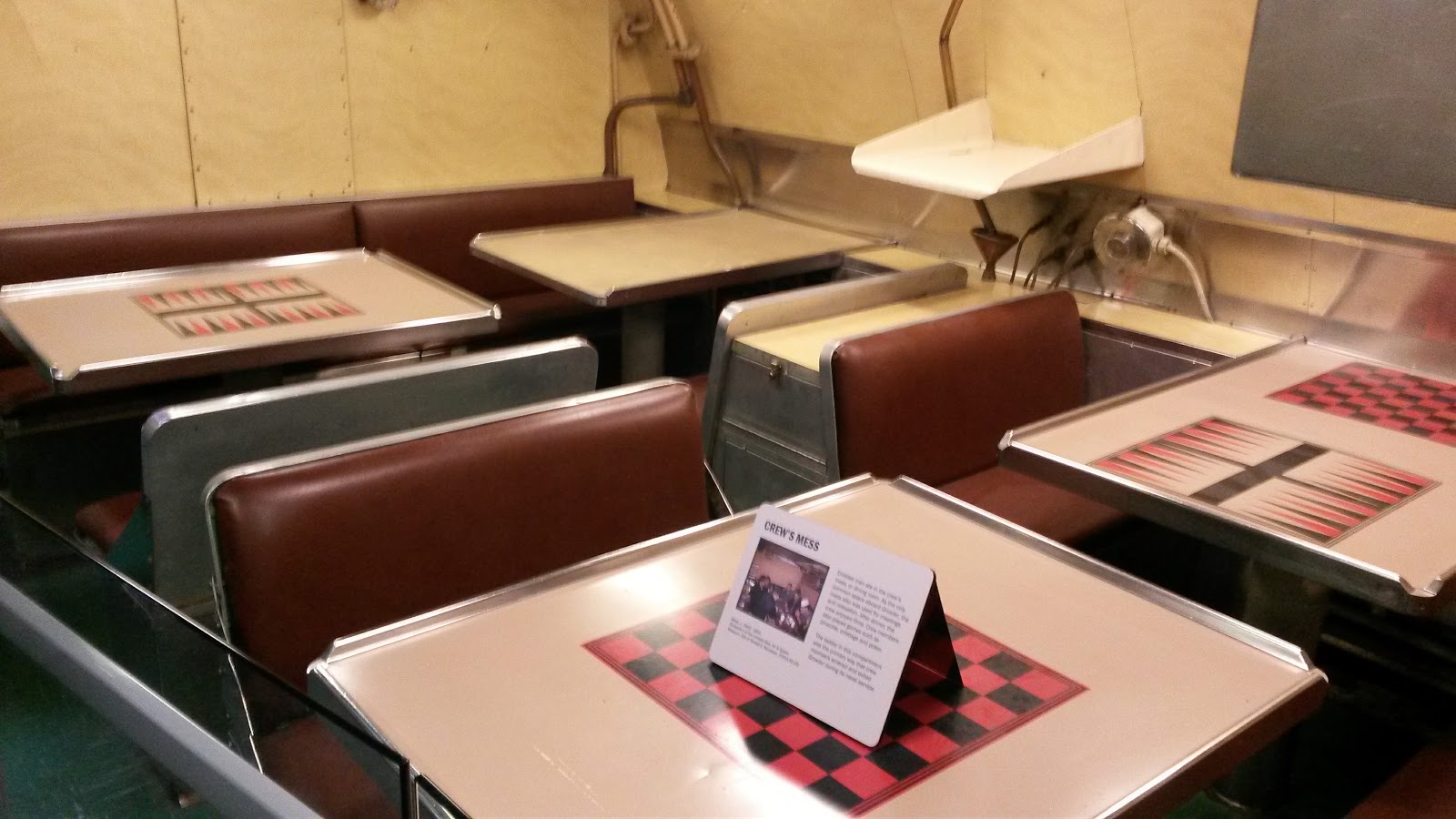
Rather luxurious mess, with built in boardgames.


Engine room.


Aft torpedo tubes.


 View from the rear deck hatch.


The Growler from the deck of the Intrepid.

It is a neat little submarine, rather smaller than the one in the sub museum at Portsmouth, and in considerably better condition than the very beaten up old Russian one moored at Peenemunde. Recommended if you are ever in NYC and can tear yourself away from The Empire State Building etc.