Sunday, 19 May 2019

Stalluponen, August 1914

I thought it was time to dig out my WW1 Russians, and inspired by Pritt Buttars 'Collision of Empires' I worked up a scenario for Stalluponen. Tim noted that we'd actually already done this twice already, but hey ho, off we go into the breach again.

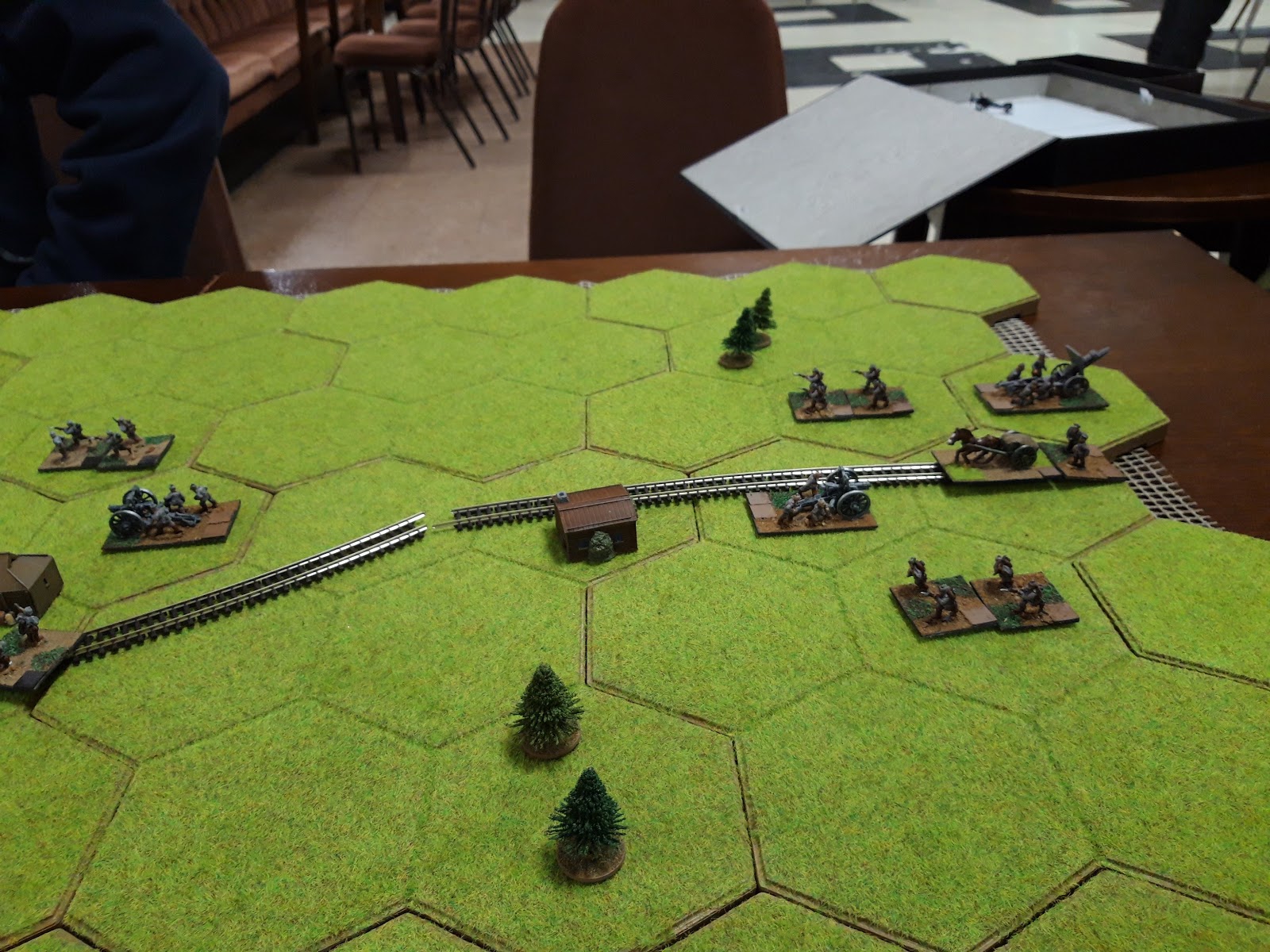
OP14, my 15mm Russians and Germans on hexon terrain. I'd cleverly managed to bring OP16 instead (which I'd set up to play on squares) so there was a moderate amount of confusion about turning limits, but we'd played enough OP14 to figure it out.


View from the north, Russans entering from the left, Germans from the right.


The enthusiastic and efficient German command team. John and Tim G.


Rennenkampfs Russians demonstrating their professionalism. Tim C, and Jerry doing his Kutusov impersonation. Tim is resplendant in my carefully converted Tsarist cap complete with Tsarist enamel badge glued on with blu tak over the hammer and sickle.


Von Francois' advance guard. I decided to use two base Brigades for this to avoid too much congestion as four 15mm bases in a hex takes up a lot of space.


The Russians advance guard was handicapped by poor C3 and logistics, a run of clubs and spades causing them to dither in position around the railway station.

The rest of Francois' Corps hurried to the front.


While hordes of Russians began to roll on.


The Russian steamroller was really quite impressive. Two entire Corps.


The German advance guard deployed around Stalluponen while the rest of the Corps hurried up.


The second division moved up to cover the northern flank. Abteilung Frank now made an appearance from the southwest.


The leading Russian Corps began to deploy around the railway line, while the second started moving ominously fast towards the southern flank. Those pesky woods rather got in the way.


A Russian cavalry division appeared form the north. Their first battlefield appearance.


This caused much excitement among the Germans who hurriedly unlimbered their artillery. Meanwhile the troops around the town had dug some rudimentary trenches. And so it starts.


16 Flieger Abteilung located the cavalry among the woods and the German field guns laid down a devastating barrage against the marching columns of horsemen.


The first Russians Corps was by now fully deployed but remained in place, fixing the Germans in position.


The German aircraft continued to hover over the Russian cavalry.


The Russians began to outflank Stalluponnen from the south as Franks brigade moved up. Again, the German artillery inflicted losses on the Russians as they began to deploy.


The Russian cavalry were quite thin on the ground now and at 50% strength any offensive potential was lost. A fairly typical first outing for a unit! They dispersed into a skirmish screen and took no more useful part in the battle.


Franks brigade was assaulted in the open by an entire Russian division while both sides artillery boomed out. Outnumbered and unable to deploy their MGs, they were driven back by the Russians.


The general situation. Lots of trenches were now appearing along the front. So much for mobile warfare!


After its early success, the German airforce was now grounded by a series of black cards.


It all now hung on the action in the south.


Abt Frank counterattacked, supported by the divisional and corps artillery. They took some losses but inflicted enough casualties on the Russians to overrun their lead brigade.


The cumulative losses broke the Russian Corps (it had lost half its infantry strength by now) and the Russian attack ground to a halt as night fell.


Jerry apparently never woke up from his nap, but his Corps was holding the front as ordered!

The Germans had come out rather better in terms of loss ratios (approx 10,000 Russian vs 2,000 Germans) and the Russian advance was halted, so they won this round. That was broadly in line with the historical experience as Rennenkampf somehow managed to fumble his massive numeric advantage (20 divisions in eight Corps vs just two Prussian divisions!) to be defeated in detail.

Historically Francois's impetuous advance and success against Rennenkampf  prompted the Germans to try their luck again at Gummbingen, with rather more unfortunate results for Germany.

As ever a good outing with OP14, and it was nice to give the Russians a taste of battle.  Seven and a half divisions engaged, resolved in an hour and a half.


Saturday, 11 May 2019

Tamamas 1809

John put this Peninsular Napoleonic game on. Ney had abandoned his VIth Corps to go on leave, Marchand took over, and moved to intercept a Spanish Army located between Salamanca and Ciudad Rodrigo. The Spanish were occupying a ridge above the village of Tamamas, the western end was very rough ground indeed so the French massed to attack the right. The Spanish outnumbered them quite considerably.
Tim and I took the French, while Tim C and Graeme took the Spanish. We played with Johns 15mm toys, using Brown Bess. Havin gplayed the Spanish in the last few games, having units which weren't all rated as 'raw' certainly made a change.


Marchands division masses on the right supported by the cavalry and a few guns. In the distance are no less than seven Spanish infantry regiments, artillery and heavy cavalry, all uphill or in the town. Fabulous.


Another three Spanish regiments over on the left with more artillery. Merced faced off against them with a couple of line regiments and one light regiment.


The Spanish centre. Light infantry in the village, with a full division in reserve.


I really like these Spanish militia in top hats.


Marchand rolls forwards. Light infantry in open order, cavalry and artillery keeping pace.


Merced meanwhile masked the western Spanish division with his light infantry, and massed his line regiments to clear the village. Somewhat unwisely the Spanish remained in skirmish order as the French columns advanced.


Marchand rolled up level with the village and the supporting artillery opened fire on the Spanish at close range. The cavalry changed formation in readiness to attack and the General moved up to gee everyone along.


Meanwhile the Spanish skirmishers were bundled out of the town, rather unfortunately disordering the massed Spanish infantry on the ridge above. The Spanish numbers told against them here.


While the Spnish sorted themselves out, Merced occupied the town. Now the French centre was secure.


Over on the left, the lone French light infantry regiment was coming off somewhat worse from engaging an entire Spanish division.


With the centre secure, it was time for Marchand to attack. The cavalry surged into their opposite numbers, and the infantry columns moved forward to engage.


After a brief struggle, the superior French numbers and quality won through and the Spanish cavalry routed away. The Spanish infantry were forced into square, and the French light infantry engaged the Spanish line.


Over on the left the French lights had had enough and ran away.


Merced firmed up his occupation of Tamamas, while the French light infantry fell back to allow the columns to assault the weakened Spanish.


One of the French columns managed to weaken a square enough to allow a cavalry charge. The column itself needed rallying after the firefight. The other French column assaulted the guns.


Having driven off the French lights, the Spanish right ponderously descended the heights to threaten the French left.


Merced re-deployed to meet the threat.


The ridge was in complete chaos as Marchand continued his assault. Losses were heavy on both sides, but the French combined arms tactics gave them a significant tactical edge.


The French eventually prevailed and one of the Spanish divisions was decisively broken.


Over on the far left, the Spanish masked the disordered French light infantry.


Their third division massed to attack Tamamas while the Spanish reserve division held the centre. The French Corps artillery moved over to support the village.


Marchand paused to reorganise before pressing on.


Meanwhile the Spanish assault closed in, led by the Spanish grenadiers.


Up n the ridge, Marchand crashed into the Spanish reserve division.


And massed up so many advantages, they got to throw lots and lots of dice.


The Spanish reserve division largely collapsed, while the assault on the town ground to a halt, so we called it a day at that point with a major French victory.

Well, that was quite a scrap! It was certainly a revelation having troops who didn't run away at the first shot, but much of the French success was due to their combination of fire, manouvre and assault, with infantry and cavalry working in tandem - many thanks to Tim C for demonstrating how it should be done in previous games.

Historically this was one of the rare Spanish victories, In the real battle Marchand kept two regiments in reserve, leaving his main assault unsupported, whereas we threw everything into the battle, Merceds seizure of Tamamas in the game was decisive, whereas irl there was just indecisive skirmishing as the French just tried to mask the Spanish right and centre.


Saturday, 4 May 2019

ISU-122 two

After doing my bodged-battery, I had the bit firmly between my teeth. Loyal readers may recall these PSC IS-IIs I did (four years ago, really?). Well, they normally come five to a box, but I only built four as I had in mind a conversion to match this:


I've had this old clunker for years. I think it is Roskopf (?) version of an ISU-122, even though the chassis is clearly a KV-1. It is pretty much 1/100th scale in terms of length and height, but the hull is  a few mm wider than my KVs.

I had in mind a conversion to make another one, based on my spare PSC IS-II hull.


I put the PSC IS-II chassis together,  but hedged my bets by not attaching the hull top. PSC provide two alternate hulls, so if it all went horribly wrong I could just build another IS-II.


I measured up and built a basic casemate out of 20 thou plasticard. I used the Roskopf model as a basis so they'd end up looking similar, but I had to adjust it as the PSC hull was narrower. I started with the top piece and adjusted the sides to fit.


It doesn't look too bad on the chassis, maybe a bit upright, but hey ho.


One thing I'd learned may decades ago while converting a couple of Airfix Pz IVs into Jagdpanzer IVs, was how hard it it is to model the chamfered angled armour cut in bits on sloping casemates. My preferred method then and now is to cut the final bits out of 10 thou card with a pair of scissors and just keep trimming it down to shape. 

After an awful lot of measuring and trimming, the wedge bits fitted OK in the end. I also had to cut bits out of the mudguard supports to get the tapered armour plates to fit.


The next scary bit was building the gun mount. In the end I made the main mount out of some trimmed bits sprue and wedged the gun barrel locating lug between the two halves. Then I made a couple of cheeks for the mount out of plasticard to hide the gaps.

It all ended up surprisingly square, solid and looked OK.  I like working with plastic, it is so easy.


Then it was on to detailing. Some hatches from the spares box, some grab rails, and other bits and piece like the drivers vision block


The superstructure just needed a little bit of filler where I hadn't quite managed to square it up properly. The amount of filling required was pleasingly little.


Here is the finishing thing, painted up and based.


It doesn't look too bad from a distance! In fact it compares very favourably with the similar conversion I did as a kid to turn to Airfix IS-IIIs into ISU-122s to go with my Airfix T34s. The superstructures on those were rather more boxy, and they ended up being used as vehicles captured by the Germans (!) as the school wargames club didn't do Russians. Oh well. The only place you could see ISU-122s fight alongside Roco Tiger IIs. Anyway, I digress.


Here it is with its pal. The most noticeable thing is the difference in the thickness of the gun barrels. I gave the older model a quick drybrush in the same green as the new so they'd look more similar, and also added a commander to the original IS-II rom the spares box. Otherwise they are just my standard Russian green with mud all over the tracks and running gear.

That was a very enjoyable foray back into the world of converting plastic kits. I must do some more.