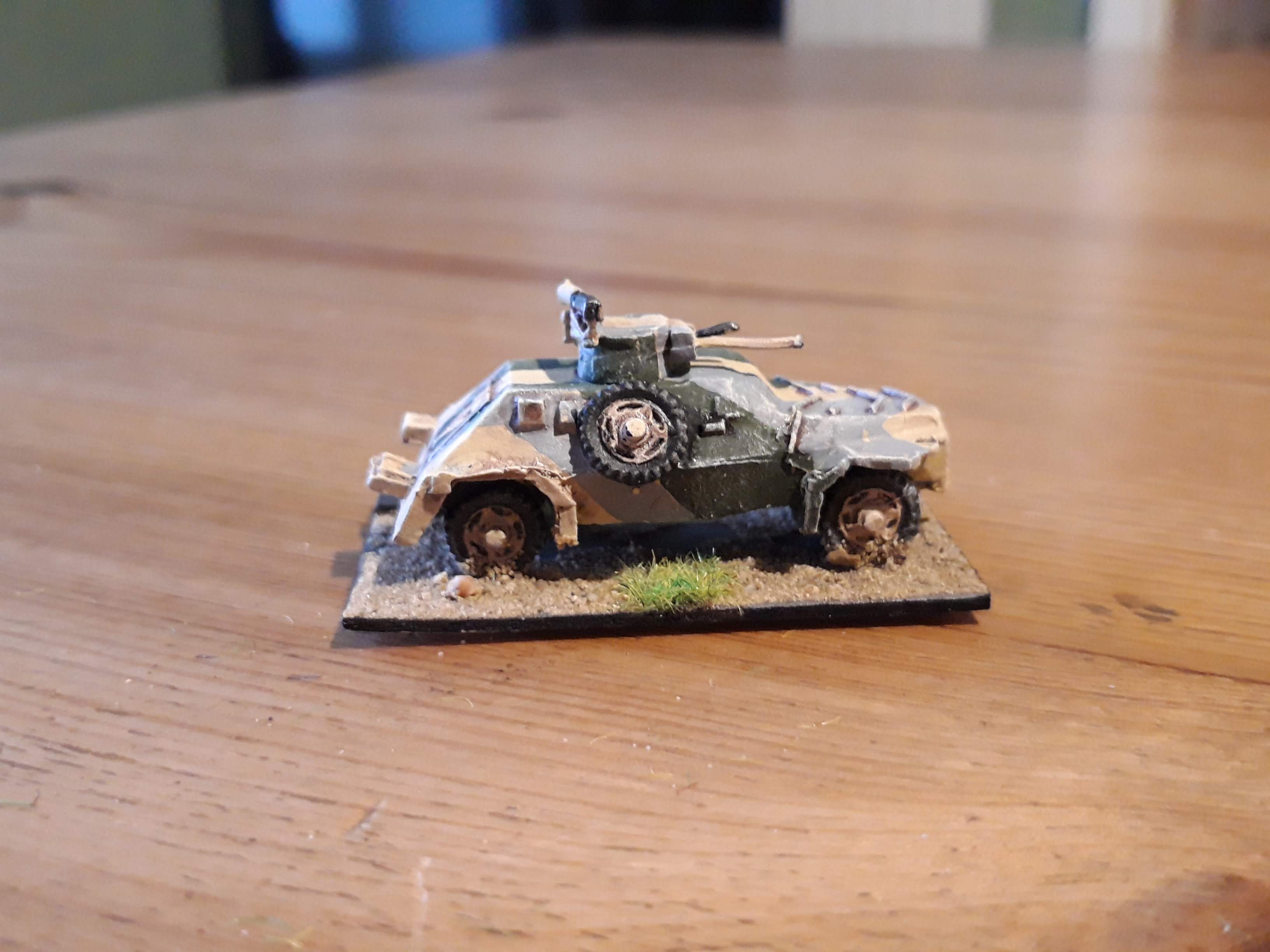
Following on from the recent Kursk game covering the 654th Jagdpanzer Battalion on 5th July, this one is set the following day on 6th July 1943 and is the 6th Infantry Division assault on Step, which ran slap bang into Rotmistrovs very poorly timed counterattack by 2nd Tank Army.

Battlefield from the south. Step is the village at the crossroads. This is an encounter battle, the Germans need to capture both the villages in the east, the Russians just need to take the large hill in the southwest or either road exit.
Pete, Jerry and Simon were the Russians, while John, Tim and Jim were the Germans.

The Russians start with 410th Guards Rifle Regiment on table, plus some residual obstacles from the previous day. The 410th Commander (Jerry) had suggested concentrating around Step to assault Hill 237, but the overall Russian CO (Pete) had over-ruled him.

So the other half of 410 GRR is up at the other village. This has a completely unpronounceable name, so was christened 'Doorstep'. RHQ is on the hill in the bottom left, and various artillery pieces are also visible. The real Russian attack was completely botched, with the Army Artillery firing a preparatory bombardment hours before any Russian units were actually in position to attack.
There are also various Lend Lease US GMC trucks concealed in the woods, waiting to support the coming attack.

Over on the other side, the Germans have IR 37 from 6th Infantry Division, dug in on hills 237 and 215 which they captured the previous day. In the pre-game setup we had some night time patrolling as both sides tried to identify the enemy positions, and German engineers located and cleared some mines.

I/IR 37 is hill 237, dug in with anti-tank guns from the Div panzerjaeger battalion. RHQ (John) is lurking nearby and a horse drawn supply column is on the rear slope. From up here they can cover the valley nicely. I'm using flat topped hills here to stop stuff sliding off them

II/IR 37 is up on Hill 215, supported by the Regimental Infantry Gun company. More supply columns in the rear and Divisional Tactical HQ (Tim) with General Horst Grossman lurking in the woods along the road.

The Russian barrage disrupted the start of the Germans own attack, and straggling up from the rear are the two battalions of IR 58 commanded by Jim. They are reinforced with engineers and more infantry guns, and supported by two battalions of 105mm guns, the Luftwaffe and the 505th Tiger Bn. At Kursk the 505th had two full Tiger companies with 31 Tigers and 15 Pz III, a mix of short and long barrelled 50mm versions.

The Russians have one or two tanks of their own. The entire 16th Tank Corps! This comprises three tank brigades, mostly equipped with T34s and T70s and supported by integral Motor Rifle battalions. I rolled all this stuff into single battalion equivalents as all the Russian units are quite weak. One of the Tank Brigades has M3 Stuarts, and the 'Grave for Seven Brothers', US M3 Lees. The Motor Rifle Brigade is supported by a Regiment of SU76s, and there is an FAC attached to the Corps to call in the Sturmoviks. The Corps commander (Pete) also gets to ride in a jazzy little Gaz 64. I rolled all the brigades into battalion equivalents as all the individual Russian battalions are quite weak, so the Corps has four manouvre units. Later in the war, Tank Corps will be stronger, but in 1943 the Russians are still feeling their way towards the optimum force structures.
The Germans problem on the Eastern Front are very visible here. They may have a few Tigers, but the Russians have lots and lots and lots of tanks, even if some aren't very good.
Pete had decided the Russians main objective was Hill 237, while Tim had decreed the German initial objective was the village of Doorstep. Lets see how that pans out.

The action opened with a massive Russian artillery barrage on Hills 237 and 215, which largely hit open ground and inflicted few losses on the Germans although it was quite suppressive. Both sides basically sat tight until their reinforcements began to arrive.

107th Tank Brigade was first to turn up and parked up behind Step.

And then Jims I/58 marched on north of Hill 215.

In the absence of any more Russian artillery fire the German supply wagons ran around distributing breakfast.

Pete pushed up the 107th very aggressively towards Hill 235, where it ran into a storm of artillery, airstrikes and anti-tank fire which left it with losses and suppressed.

The rest of IR 58 had now come on, marching along the road south of Hill 215, so Johns II/37 joined Jims I/58 advancing towards Doorstep.

332nd Tank Brigade was now in line. Sturmoviks strafed Hill 235 while the 107th was replenished. The German AT gunners on Hill 235 kept the Russian tanks under steady fire while the artillery continued to rain down.

The German infantry in the north was now advancing very aggressively towards Doorstep. Jim marched adjacent to the village while John set up his Infantry Guns to provide covering fire from the cornfields to the south. The 505th finally drove on and took up a covering position on Hill 215.

They do look rather menacing! If a bit stupidly big for the hex. They can engage Russian armour four hexes away from up here, but so far the Russians aren't quite in range.

The 353rd tank Brigade now rolls up, with its mighty 'Graves for Seven Brothers', and parks up behind Step before joining the fray.

Jerrys artillery spotters have finally got some targets and pour fire into I/58 out in the open near Doorstep.

All three Russian Tank Brigades assemble beneath Hill 235 as 200th Motorised Brigade moves up to Step. The Germans continue to shell the Russian tankers in the valley below without doing much damage.

Meanhile the Germans put in a massive assault against Doorstep. Bombers and artillery pound the village, II/37 provides covering fire as I/58 assaults the village. The assault has no great expectation of success but it will stop the Russians reorganising. Jims other battalion uses the covering fire as an opportunity to move up through the cornfields to the edge of the village too - in position to assault next turn.

The Tigers decide to come off their hill and engage the Russian tankers in the valley. Not sure that is a move I'd have made, but the wire and other obstacles at least screen them from nasty Russian counterattacks.

At Doorstep, Jims first assault is repulsed, but enough losses are inflicted on the defenders that they become disorganised. The defenders can't rally as they were assaulted, so instead they fire on the Jims other battalion, inflicting a few losses, and more importantly, suppressing them with artillery fire.

The German anti-tank gunners on Hill 237 are looking a bit shaky so John resupplies them, meanwhile the entire Tank Corps rushes the hill, covered by the Sturmoviks! 200 Motor Rifle moves up in support. Pete decided to completely ignore the Tigers on his flank.

Over at Doorstep, the Germans are out of artillery ammunition, but the Luftwaffe and Johns II/37 shoot in Jims second assault. This attempt (reinforced with engineers) is successful against the weakened and disorganised defence and the village is overrun, and the surviving Russians withdraw. Jims other battalion takes the opportunity to reorganise in the rear.

The Tigers pour fire into the flank of 16th Tank Corps, leaving the Steppe littered with burning Russian tanks. There are an awful lot of Russian tanks though. The German gunners are weak and disorganised now and their fire is largely ineffective.

The Russians continue to ignore the Tigers and focus all their fire on the German AT gunners. The brigades in the valley fire while 200 MRB moves around the southern flank, and finally the 332nd Brigade puts in an armoured overrun attack. A flank attack by an entire Tank Brigade against a disorganised enemy, about the best attack possible. The Germans are overrun and the survivors flee west. Hill 237 has been taken by the Russians.
So far both sides have been exemplary in their maintenance of the aim and concentration of force, piecemeal attacks just don't work in these rules. Personally I would have put the Tigers in Hill 237 where they could do more good, as two AT units would have shot the Russians to pieces. The third military principle, economy of effort.

The Germans break off the tank battle and instead divert the Tigers to Step, as the German infantry march south behind them from Doorstep. Jims troops are a bit raggedy so will need some reorganisation before their next battle, and the plan is to leave one to garrison Step.

The Russians don't respond and instead the mass of armour just continues to motor north, with their eyes on more objectives. 200 Motor Rifle takes one of the road exits and the badly shot up 335th Tank Brigade reorganises. The 332nd Tank Brigade takes the lead and the FAC moves up to join them.
Where will the Russian tanks go next?

The unsupported Tigers come a bit unstuck against the dug in Russian infantry. The Russian artillery inflicts a hit, as well as the infantry - presumably some heroes with Molotov cocktails as the 45mm AT shells just bounce off. John uses the cover of the tanks to move his infantry up through the fields to the edge of the village.

Back up the road, Jim stops to reorganise both his units. Should the Germans have waited a turn before moving south to Step? Well, we will find out later as it was time to break for the night at that point.

While 200th Motor Rifle Brigade grabbed another objective, the rest of 16th Tank Corps wheeled north east and parked all three tank brigades on the rise leading east from Hill 215. The 332nd ran into a hail of German artillery fire and then suffered the indignity of a Close Assault by Jims engineers! The Russian tankers took heavy losses and became disorganised although the engineers fell back too.

At Step, the Russians concentrated their fire on Johns infantry while the Sturmoviks stonked the Tigers, to no effect. The Tigers put in an assault covered by Johns infantry guns.

The assault failed, but all the German artillery and bombers concentrated on Step, causing heavy losses among the defenders. Johns infantry reorganised to conduct an attack next turn.

As MRR 200 occupied Hill 215, the Russians reorganised the 332nd. The rest of the Russians and the Sturmoviks massed their fire against Jims disorganised engineers and routed them.
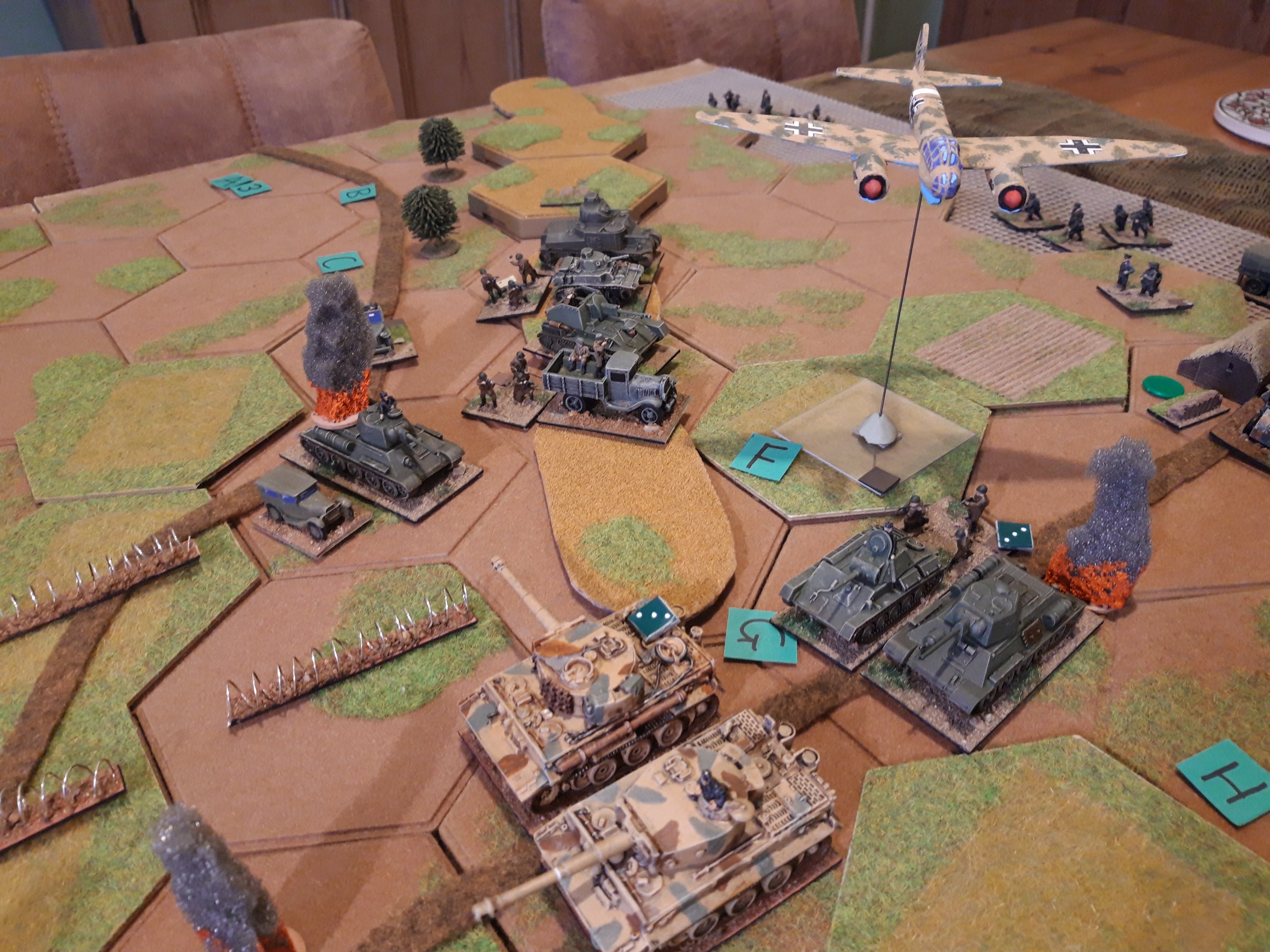
The Russians then launched a catastrophic attack on the 505th. One brigade assaulted the Tigers (in fairness it was a flank attack so got six dice) and another manouvered into their rear. The T34s were repulsed and then finished off by the Tigers, while the other Tank Brigade was pummelled by the Luftwaffe and Jims infantry in Doorstep. I think the Russians had got a bit carried away with their earlier successes and forgot the principles of concentration of effort.

To make things worse, John called in artillery to cover the reorganisation of his infantry and the barrage destroyed the last defenders of Step! It was wide open for the Germans to just walk in.

The Russians were saved by the bell however, as the random game ending decreed that was the last turn. So at the end the Russians had taken all their objectives, but the Germans didn't have theirs. One more turn would have been a draw, and also the end of another Russian Tank Brigade, as it was, the Russians were left looking rather thinner on the ground than might have been expected.
Historically 16th Tank Corps ran piecemeal into the combined guns of the German AT screen and the Tigers and were shot to bits, so the Russians did somewhat better than real life, so giving them the game seemed reasonable.
That was an interesting game for two reasons, first both sides came up with decent plans and stuck to them, although having obtained their initial objectives, they both charged off in a rather disjointed fashion. Secondly, the players are getting better at tactics - massing fires and optimising the use of their artillery and logistics assets, so the ratio of attacker to defender losses is going down. It did fall apart slightly in the latter part of the game as units were served up piecemeal against superior numbers. The excitement of the moment I expect.
That was an exciting mobile action, almost Panzerblitz-like, and visually impressive.
That was the second game in a series of three, and I hope to run the concluding chapter shortly. Watch this space!