Saturday, 30 January 2021

Escape from Tula

 I had actually lined up a different game,  but then as I was planning to run this in the third week of December, I thought a winter game would be fun (like last years outing to St Vith). That meant digging out the snow cloth, which in turn meant yet another One Hour Wargame, about the only thing I play with rulers over Zoom.

I was looking for something around Stalingrad, but in the end plumped for Zhukovs counter offensive around Moscow. There was a considerable amount going on in the vicinity of Tula on 16th December 1941 as Zhukov tried to encircle Guderians 2nd Panzer Group and I thought one of the 'flank attack;' scenarios covered the Germans tactical dilemma rather nicely as Soviet blocking troops infiltrated through the huge gaps in their lines and disrupted their attempts to fall back to more defensible positions and reorganise.

At this point, all the units were drastically under strength. The Russian ones had barely rebuilt from the bloodletting earlier in the year, while the Germans were at 20% strength or less. This scenario therefore featured an awful lot of 'divisions' with only two battalion sized stands...


The initial setup. The German column (representing Geyr von Schweppenburgs XXIV Panzer Corps at approx 20% strength) is heading down the rail line. The Russians (elements of Boldins 50th Army) have managed to insert a blocking force ahead of them, while the rest of their troops swing in from the right flank. To win, the Germans have to escape with half their force (three units) via the rail line to the west, anything else is a Soveit victory.


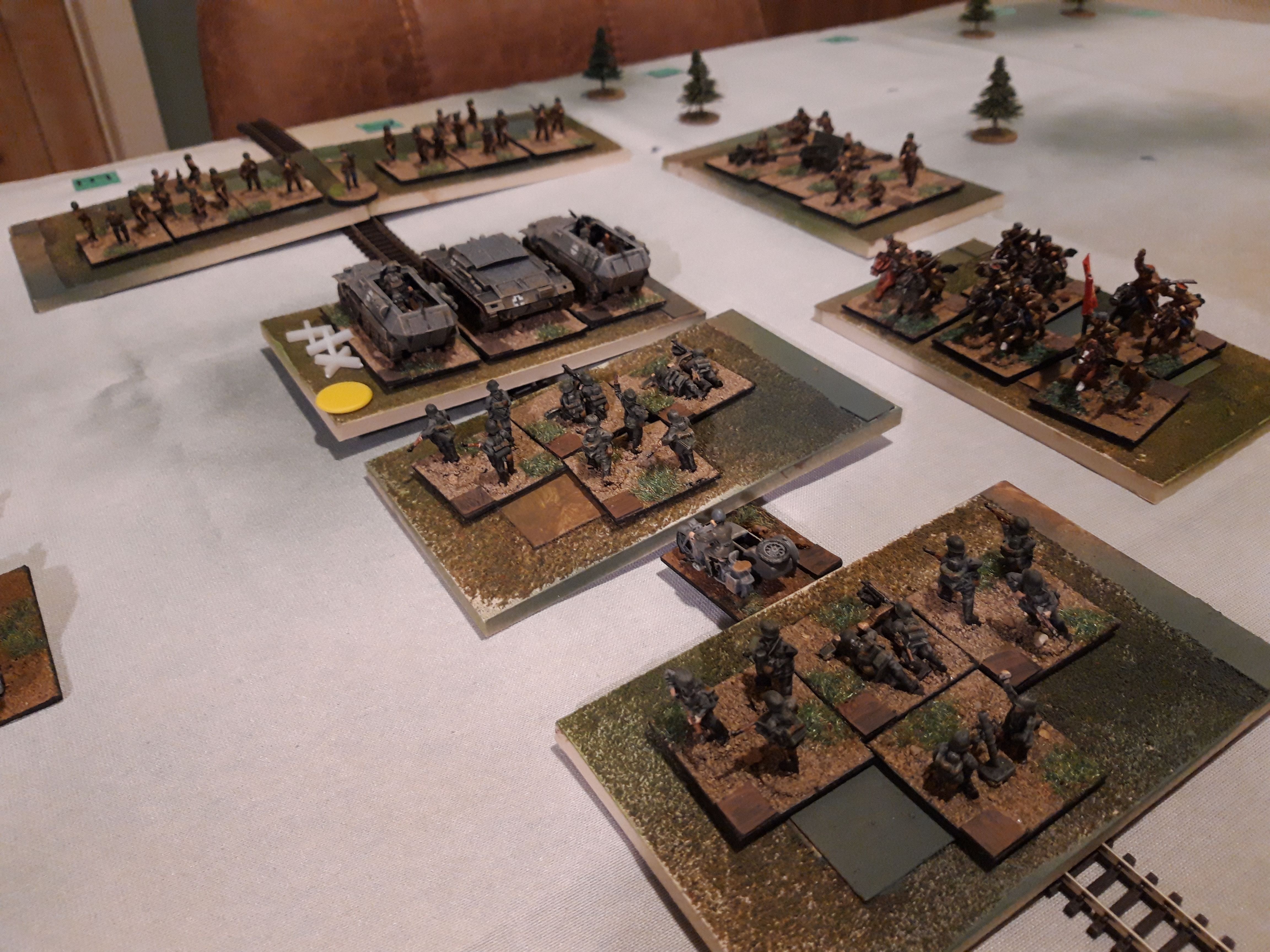
The German column from the rear. In order from the camera, 3rd Mot Division (Simon), 3rd Panzer Div (John) and finally Panzer Group Eberbach aka 4th Panzer (Tim C) accompanied by Geyr Von Schweppenburg. All the remaining German armoured and tracked elements are concentrated under Eberbach at the front. 


7th Ski Brigade (Mark) is across the railway line in their way. irl XXIV Panzer Corps had about 50 operational tanks by now, but had also massed all their remaining halftracks mainly stripped from armoured engineer companies into a composite panzergrenadier battalion supported by SP guns, which I guess were Stugs but might have been Jagdpanzer 1s.


The rest of the Russians are 18th Rifle Brigade (Mark) nearest the camera, 15th Cavalry Division (Pete) with two regiments and finally 141st Tank Brigade (Tim G). There is also a detachment of NKVD to encourage shirkers to greater efforts.


The NKVD urge the cavalry onwards.


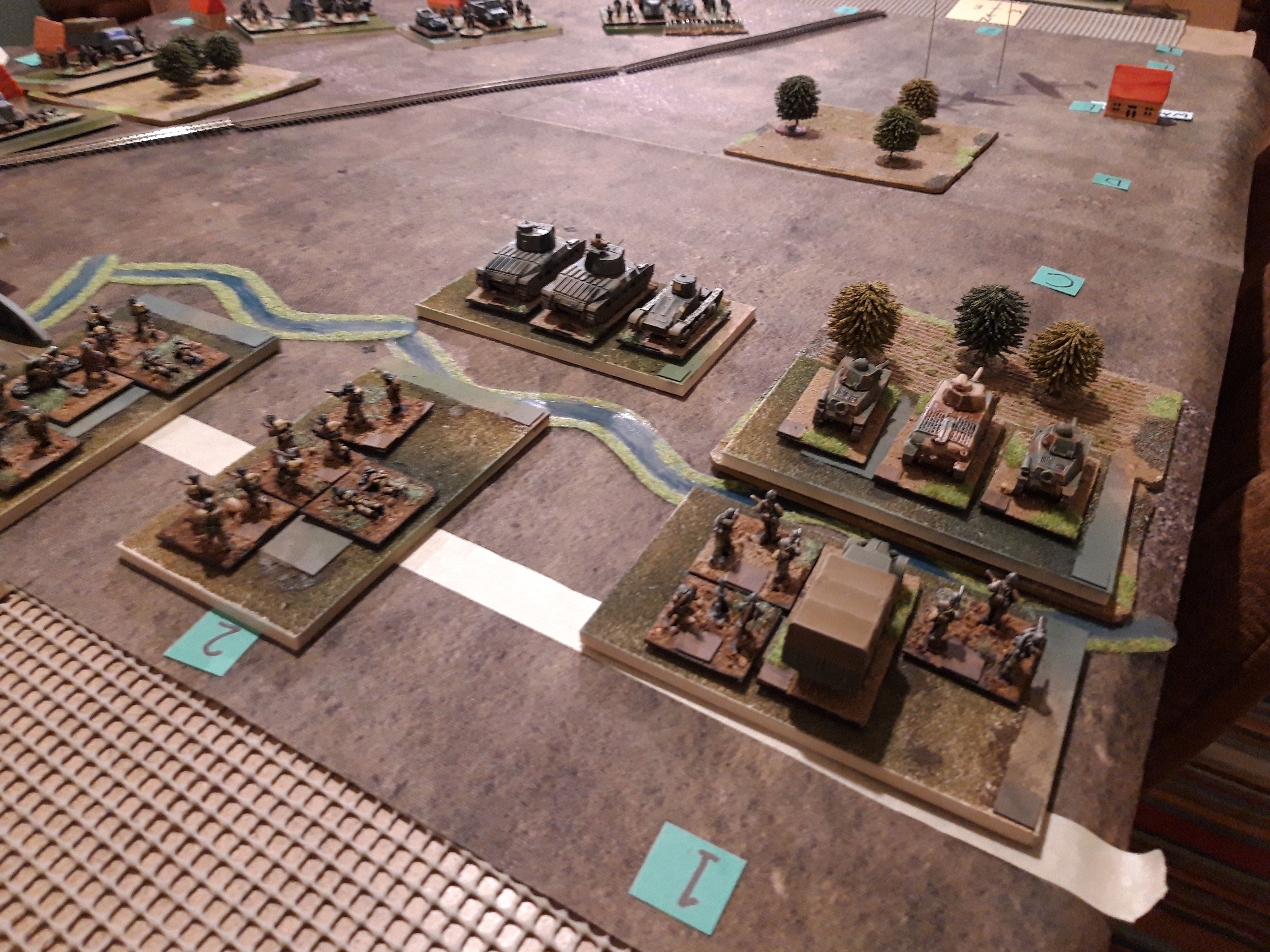
Tims tank brigade. Even this late in 1941 the majority of Soviet tanks available were T-26s, with a few T34s and KVs mixed in. The tanks are tucked away out of sight behind the ridge.


Panzer Group Eberbach, 4th Panzer Regiment and 4th Schutzen Brigade respectively. Geyr von Schweppenburg gives a morale bonus. The Germans had decided to try and smash through rather than use their central position to fall on the Russians to the north, worried they'd run out of time.


The opening moves saw the Soviet line to the north surge forward and the Tank Brigade occupy hull down positions on the hill. The Germans stolidly plodded forwards but 3rd Mot veered off to engage the Russians.


At the head of the column the panzers moved south for an outflanking manouvre but the mechanised infantry group ended up being the sole target of three Russian units and suffered heavy losses, becoming disorganised.


3rd 'Panzer' Division closed up behind and the Russian cavalry got scarily close.


One regiment of 3rd Panzer engaged the cavalry while Von Schweppenburg moved back to bolster the mechanised infantry.


In turn the Russian Rifle Brigade slammed into their flank. Ouch. The Germans were paying the price for putting their head into the trap. The Germans were annihilated in close combat.


Further back along the line the Russian cavalry was heavily engaged and the German infantry units had largely given up trying to dash to the west. 3rd Panzers leading regiment was now facing with same dilemma as the mechanised infantry.


Simons reserve regiment was still unengaged however and moved back to the railway line. Lots of disorder markers now appearing in the close battle.


The Panzers tore into one of the ski battalions, which had very wisely turned to face, but sadly wasn't dug in and didn't have any significant anti-tank support. Oh dear.


The Russians returned the favour as their Tank Brigade came down off the hill into the gap left by 3rd Mot. The Russian cavalry was looking distinctly ragged now.


Johns leading regiment was now caught between two Russian units and outflanked with heavy losses.


The Russians destroyed the leading regiment of 3rd Mot but in turn the reserve regiment assaulted the Tank Brigade in the side, inflicting enough losses to disorder it.


Johns reserve regiment continued to battle the Russian cavalry.


And put them to flight with light losses.


Unfortunately 4th Panzers lead regiment, outnumbered and outflanked, was destroyed, although the Rifle Brigade was fairly chewed up in the process


The Panzers meanwhile had overrun one the ski battalion facing it without any losses at all! Tanks against infantry in the open are quite good.


With their line now rather tatty and with both units carrying a number of hits, the Soviet Tank Brigade and surviving cavalry withdrew to reorganise.


Further west the Russians fell back behind the railway line in the face of the mighty panzers, the way to the west was open!  The Rifle Brigade busily reorganised itself to face the armoured onslaught.


The German infantry now began to pile down the railway line heading for the exit, and the Russians responded by rapidly redeploying their (slightly) replenished Tank Brigade. The cavalry were still sorting themselves out.


The Panzers meanwhile engaged in a gunnery duel with the remaining ski troops.


While John reorganised, Simons remaining regiment marched west and the Panzers pulled forward right up to the rail line to keep it open.


Suddenly realising that the Germans had a chance to escape, the Russians threw all their units into combat, regardless of their current state. The NKVD chivvied the cavalry along. The most important move was from the Russian Tank Brigade, which assaulted Johns last infantry regiment and pinned it into place. The Germans would only be able to escape if they defeated the armour to their front.


The Russians all-out attack paid off and Johns disorganised infantry disintegrated under the Russian tank assault, which left just Eberbachs panzers and the remains of 3rd Mot to leave the table to the west. As the Germans were now only able to exit two units, it was a Russian victory.


The surviving Germans were in a good position. The Russian infantry didn't really have an answer to the panzers, although if they'd have dug in it would have helped, but they never had time, and there wasn't any difficult terrain to hide in.


The surviving ski troops and the Rifle Brigade still had a couple of hits on them at the end.


As did the Russian tanks and cavalry, despite taking a couple of turns out to reorg. 

That went really well, even if it ended up being a quite a short game. Both sides have a number of tactical options - do the Russians try to relieve their blocking force or just attack the German column? Do the Germans exploit their central position to defeat each Russian wing in turn or concentrate on on breaking out? In the end the Germans opted for a dash for the exit, which was always going to be a bit problematic for the unit at the very front. It is a scenario which warrants some replay.

I'm very pleased with this iteration of the rules. They give a good game over Zoom, despite the absence of grids and the players have meaningful choices to make. I'm, particularly pleased with the way the reorganise mechanism works as it gives the players choices about how aggressive to be, but also encourages them to think about how to fix the enemy in place so they can't escape. As Patton said, "Hold em by the nose and kick em in the pants". The big bases also let me field lots of toys, which I think is fine for the level of battle being represented. It isn't as if I've got anything else to do with them.

Finally, eagle eyed students of history may have noticed that this engagement bears a distinct resemblance to Salamanca and it is indeed a disguised scenario. The battle starts at the point Wellington has inserted a division between Marmonts advance guard  and the main body of the French army. The hill to the east (used so effectively by the Russian tanks) is standing in for Los Arapiles.  

Another great scenario from One Hour Wargames.

One thing which did occur to me after the game was that if I'd just turned my movement bases over so the white side showed, they would have looked a bit more like snow. Oh well. maybe next time.


Sunday, 24 January 2021

Grapple-X

 In a welcome addition to our usual lineup, we were joined by a contingent from the Holborn Gaming Group down in That London/Kings Landing. John B offered to run one of his single session committee games, this time covering  a British H-Bomb test in the late 1950s. So, maximum Cold War sleaze then.

The game itself was pretty free format. The players all had general briefings and role specific objectives, and we then essentially talked out way in or out of trouble, depending. Some structure was provided by the game being set around a formal enquiry into the Grapple-X test, which may have gone slightly awry. 

The new whizz-bang was being tested in the Whitsun Islands in the South Pacific, and may have landed a tad closer to habitation than was intended. Ooops!


My role was Governor of the Whitsuns Islands, and I was mainly concerend with making sure that whatever might have gone wrong (and we didn't know for sure that it had) was absolutely nothing to do with me! I was also a bit concerned about the whereabouts of the islands Chief Medical Officer who had gone AWOL. Finally, after that spot of indiscretion at the Kitty Club I had a few dark secrets, and I needed to ensure that all of that remained strictly hush hush.


Various bigwigs on the Committee of Enquiry interviewed the witnesses to the exercise, and gradually the appalling truth became apparent(ish). Well, never give a Lt Commander a map at short notice is all I can say.

Luckily all the interest in the technicalities of just how big a bomb it was, and how the Royal Navy and RAF could fail to find a target the size of an island was an excellent distraction from the more sordid goings on in Soho, and no unpleasant style Profumo scandal emerged.


In the end the committee decided the whole thing was largely the fault of the German origined nuclear weapons designer at AWE Aldermaston and resolved to keep johnny foreigner well away from our nuclear secrets in future. Let the Americans do that sort of thing.


It also turned out that I needn't have worried too much about my sordid past , as there were several other dubious characters knocking around as well. Shame about the islanders, still I'm sure their hair will grow back.


That was great fun, and the players role played to the hilt. It made me all nostalgic for the good old days of the Cold War when you knew what was what.


These bad boys used to fly low over my house in the mid 1960s. My Dad reminded me that you could also see the end of the runway from the garden. Mmmm, don't think we'd have to worry too much about the fallout then.


Saturday, 9 January 2021

Table Battles - Little Round Top

 In a change of pace form Bosworth, Tim put on another Table Battles game and this time we headed off to Gettysburg and specifically Little Round Top. Being a card game, there isn't really much blog friendly eye candy, but here is the 'battle' such as it is.


The Rebels have two wings, the red wing has three regiments facing off against two Yank ones, while the yellow wing also has three regiments, two of which are fighting two US regiments and one is pulling a sneaky outflanking manouvre via Devils Den.

As with the other battles in this series, the battlefield layout is managed by which cards are allowed to attack other cards, and in what sequence. Each CSA unit can only attack its historical counterpart, and if it wins, can move on to attack another nearby one. The CSA units all have five strength points as opposed to the US ones with four. The CSA layout is therefore quite straightforward, but the US is far more complex as they are deployed in two lines in difficult terrain with artillery support.

The US have more cards, but only four of these are front line combat regiments (the dark blue units). The rest are special units, one is artillery which can stop attacks dead, another are sharpshooters attached to 20th Maine who can basically get extra hits vs 15th Alabama, one card represents Devils Den which has to be 'attacked' to get at the units behind it and finally the last unit is Weeds Brigade which hangs around in reserve and can absorb hits instead of the US front line. This turned out to be pretty decisive.

As these battles are normally quite quick, Tim ran it twice over two days. On Tuesday Pete and myself took the Rebs, while John, Tim C and Jerry took the Yanks On Wednesday, we swapped sides and Richard joined the US team too.

Day 1
We built up a series of multi-dice attacks, trying to generate a favourable loss ratio. We didn't bother with Devils Den and just attacked frontally. Unfortunately the US used the time we spent building up our attacks to reinforce their defences and our attacks were either halted by artillery fire or frustrated as Weeds Brigade pushed its reserves forward. In the end US attacks routed two of our weakened regiments and the CSA gave up.

Day 2
As the US we tried to replicate the tactics of the day before (piling command dice onto the artillery, reserves and sharpshooters while mounting the odd counterattack). The Rebs tried something different, and launched a series of low odds (one dice) attacks which caused them some losses but forced us to keep reacting and burning the dice on our defensive units. This was very effective and their attacks inflicted losses on the front line at a faster rate than Weeds Brigade could push reserves forward, although there were heaps of dead Rebs in front of the US positions. Finally, one of the US units was reduced to one step and the Rebs launched an attack to destroy it, but they hadn't noticed that we had a single reserve dice left which absorbed the hit and instead it was the Rebs which were routed. Next turn we attacked with 20th Maine, reinforced with Sharpshooters, who routed 47th Alabama and the US were victorious again.

That was a much more close run thing, well done to the CSA for playing so well. To be honest, they deserved the win and I suspect if we'd been playing f2f they wouldn't have made their fatal mistake. 

This really is a fascinating game and Tim and I both pondered how we might design some other scenarios (I am drawn to some WW1 trench warfare ones), but getting the interactions right between the various options is the sort of thing which makes my head hurt. Great stuff, very enjoyable.


Saturday, 2 January 2021

2020, thank goodness that is over

 Well, that was an interesting year and hopefully not one to be repeated again in my lifetime. I shan't overly dwell on the shortcomings of our leaders in these difficult times, but I'm hoping there is a special place in hell reserved for both the bumbling incompetents and the corrupt disaster merchants shovelling our cash into their mates pockets.

Helping to transition the entire organisation and all its customers into a remote working environment while also figuring out how to operate our teams and maintain our services remotely has also been quite an interesting experience, not helped by the rather more challenging security environment.

Among all the chaos and confusion, wargaming has remained a delight however, and a particular shout out to the stalwarts of Sheffield Wargames Society and Wargames Developments who have helped make this year more bearable. We've managed to run regular on-line games since March and have actually become quite proficient at it. A real highlight of the year was the Virtual Conference of Wargamers back in the summer, and I'm looking forward to the winter VCOW in February.

I've also managed to make a big dent in the lead pile and have done my best to keep at least some figure manufacturers in business, and I've enjoyed the challenge of designing and running games suitable for an on-line environment.

So now it is just heads down until the vaccine is rolled out and hopefully a return to greater normality later in the year. 

Happy New Year everyone!

Just a reminder of a few great games.


Arras 1940


Nachod 1866


Kasserine Pass, 1943


Bir el Gubi, 1941


Operation Goodwood, 1944


Saturday, 26 December 2020

One Hour Arras

 Having overdone NBC a bit, I thought I'd dig out my One Hour WW2 rules variant again. Simon had found an interesting Arras scenario on the interweb aimed at a variant of KISS Rommel, itself based on Bob Mackenzies lavish Command Decision scenario covering the same battle. I thought about doing it with NBC, but with half a dozen battalions on each side, it was a bit on the big side, so One Hour WW2 came to the rescue. We've done Arras before with my Memoir 45 variant of Memoir 44, so I had all the kit, although for this one I'd got the proper French tanks (Somuas and H-39s) instead of a Char B in German colours and my SCW FT-17s!

The scenario was done using an 8x6 hex grid so it would have been easy enough to convert to NBC but I squished it into a standard 3'x3' OHW table with a bit of lateral compression. I also made up some new air support rules, the Germans had two Stuka attack dice from turn 5, but if an attack rolled a '1' the stuka was removed (shot down, ran out of bombs or whatever).

Tim G was back from his travels, so we had a respectable turnout. The British were Tim C and John (with a tank battalion and infantry battalion each) and Jerry got 3 DLM (a tank battalion and a battalion of motorised infantry). Tim C was in overall charge so got to direct the Royal Artillery as well.

Tim G and Pete were 7th Panzer Div, having a rifle regiment each. Pete also had II/25th Panzer Regt and Tim G filled in the role or Rommel so also go the divisional artillery, Flak battalion and Stukas. Tom played those nasty SS Totenkopf chaps. 


The Germans. L-R. 6th Rifle Regiment, 7th Rifle Regiment, II/25 Panzer and SS Totenkopf behind. The divisional artillery is to the rear, Rommel and the Stuka FAC in front and the 88s are attached to a a battalion of 7th RR.


The Allies. L-R. 3DLM with a cavalry tank battalions (Somuas and H39s) and motorised infantry battalion. Right column (Tim) with 7RTR and 8 DLI, then Left Column (John) with 4 RTR and 6 DLI. The column order is backwards as the British are approaching from the north and we are in the south, if you see what I mean...


Battlefield from the east. Arras is in the north east. The battlefield is fairly featureless with just scattered villages and small woods, irl there was a low ridge east of the rail line but I left that off. The British have to capture and hold just two of the numerous villages scattered across the map, with the caveat that only the French can take Waquentin in the far west, and only the British can take the rest. That sounds easy doesn't it.


Arras. This is treated as impassable for game purposes. It is well garrisoned and both sides avoided it during the battle. It just modelled it as surrounded with wire and with some 2pdrs and Bofors guns inside. The village of Achicourt due south.


The RAF and Luftwaffe duel over the battlefield. Tim helpfully pointed out that this is a BF-109F and a Spitfire IX. So at least we had a good video link!


View from the northwest. The table was notional gridded up into 6" squares to aid with the location of terrain features and reinforcement entry points, but I was going to run the the game using free (ruler) movement. It just seems to work better that way.


The opening moves. The leading German motorised battalions came on from the east and south respectively. Rommel was in the centre with 7th RR, Totenkopf over in the south centre.


The Allies brought all their tanks on (both sides were restricted to three units entering on turn one). 4 RTR swung though 90 degrees and headed for the bridge, although the stream was only a minor obstacle. The Allies were facing the slightly tricky manouvre of having to swing their whole front through 90 degrees as they manouvered around Arras, very easy to end up with one wing lagging behind. 


The German line began to form in an arc running south from Arras then southwest to Totenkopfs position at Betencourt. Already the leading units had their entrenching tools out.  


The 88s move up on Rommels right. I modelled them as being attached to one of the rifle battalions to keep the unit count down. Having an entire Flak battalion attached was sufficient to make this unit count as 'heavy infantry' with heavy AT guns too. Nasty! I discounted the 7th Panzer AT battalion (which was present) as the 37mm guns were completely ineffective against the Matildas and fairly useless against the Somuas too.


The Allies brought on their infantry. The stream wasn't much of an obstacle, but the French also had to negotiate some woods. The Allies knew the Germans panzer regiments were off to the west so the French had to provide a modicum of flank security. By this time 7th Panzer had not only its own regiment but  another one, 25th PzR, purloined by Rommel from another division. 6DLI has some attached 2pdrs. In the real battle they spent most of their time shooting at the French as the gunners didn't recognise the tanks.


4 RTR and 6 DLI negotiate the bridge and head for Achicourt.


7 RTR forms up in the centre while the French push on through the woods.


One lonely battalion of 6 RR faces off against three battalions of British. Unfortunately instead of a massed attack the British are now feeding their battalions in one at a time. A couple of turns spent forming up in the centre might have been useful. 


Both sides exchange artillery fire. The exposed infantry take losses and are disorganised by the shell fire.


Meanwhile the rest of the German line is busy digging in. Rommel moves to join the 88s. He imparts both a morale and combat bonus, at some personal risk.


The German front is starting to look quite solid.


But sadly the German infantry in Achicourt are shelled by artillery and assaulted by the Matildas before they have time to dig in properly. They become exhausted and are removed as they are combat ineffective. In better news for the Germans, 7th RTR strays a bit too close and is badly shot up by the 88s. The German FAC has now joined the other battalion of 6 RR in the woods, 


The French cavalry have nearly taken Waquentin.


Rommel acts, and moves his battalion with the 88s to support 6 RR in the woods. Every gun in range opens fire and the Stukas range down, but it doesn't stop 4th RTR making a devastating flank attack against I/6 RR which takes four hits despite being dug in. Ouch. Under a torrent of shell fire and bombing, 6 DLI have had enough take no further part in the proceedings (air and artillery are very effective against soft targets in the open).


7RTR starts to reorganise and is joined by 8 DLI.


The French take Waquentin. Vive la France! Having taken both Waquentin and Achicourt, the Allies have achieved their objectives. Now they just need to hang on to them.


8 DLI moves up to support 4 RTR and I/6 RR are also soon heading for back to Germany . 4 RTR comes under heavy fire and is disorganised though. The 88s aren't too bothered by the Matildas armour although they come under indirect fire from 25pdrs and suffer some hits.  


The Stukas and German artillery remove 8 DLI from the fight but Rommel takes more hits. He survives (just!). 4 RTR are still in the fight as the heavily armoured Matildas shrug off loads of damage.


Oooer, whats this? II/25th Panzer rolls up right behind 7th RTR! If only the French had dug in to protect the Allies flank.... both sides exchange fire, the Pz 38s operating at a big disadvantage against the heavily armoured British, but the Germans score one hit, enough to disorder the already weakened 7th RTR.


Further south the French face off against Totenkopf and 7th RR.


The Germans are getting a bit short of troops in the north now that the whole of 6 RR has been removed. Only Rommel and his 88s hold the line.


Rommel steps forward for a better look as shells land all around.


SS Totenkopf. I included their 100mm artillery battalion as an integral component, making them into 'heavy infantry'. irl this battalion was overrun fairly early on and fled, leaving its guns behind.


The desperate fighting south of Achicourt continues as Rommel and 4th RTR pound each other, with every artillery piece and Stuka in range joining in.


II/25th Panzer moves to assault the Matildas a close range. A good move as flank and rear attacks are doubled, which offsets the Matildas armour advantage. As the British aren't pinned frontally, they will be able to turn to face in a future turn.


In a bloody climax, II/7 RR takes five hits and only survives as Rommel is with them. Rommel avoids an untimely demise by a single dice pip and one of the Stukas is downed. 4th RTR finally succumbs to the German fire and the plain in front of Achicourt is littered with burning tanks. The Allies still control two villages though... 


The tank battle in the centre continues. II/25 Pz manages to inflict another hit on the Matildas (they were hideously unlucky in their assault). Meanwhile the speedy French cavalry tanks move rapidly up behind the woods in support.


German artillery and air rain down on the Somuas but the Matildas turn to face.


Caught between two fires, the result is predictable and the panzers are burning. They might have been better off disengaging and heading for the Allied supply trucks, but the opportunity to hit 7 RTR in the rear was a bit too good to pass up.


With an absence of observed targets, and an absence of units, the Germans bring their divisional artillery on to the table at Beaurains to help hold the line. irl it was only the gun line of the divisinal artillery and Flak which stopped the allied attack. 105mm LeFH were surprisingly good at dismantling Matildas with direct fire. Matilda Is were literally blown apart by direct hits.


The Allies respond in kind and the Royal Artillery position their 18/25pdrs to protect the supply head.


The Germans get their shovels out and frantically start digging in while the allies reorganise. The allies are a bit hamstrung as only the British can take the eastern villages, and they only have one ground combat unit left now (7th RTR). It wouldn't stop the French from taking them and handing them over though, but this idea doesn't occur to the Allied commanders. 


Things take an interesting turn in the south! SS Totenkopf decides to take advantage of the allied concentration in the north and drives forward towards Waquentin. The French motor infantry retrace their steps and the French and SS engage in bitter hand-hand combat. Unfortunately this opens a big gap in the German line and 7 RTR is not slow to take advantage  of it. The Matildas rumble southeast, bypassing the German gun line.


I/7th Rifle Regiment hastily undigs itself and moves into a blocking position, accompanied by Rommel himself. The SS and French continue to fight, the SS slowly getting the upper hand due to their superior firepower.


This interesting development is too little, too late however, and after an exchaneg of gunfire, time runs out before 7th RTR can try their luck against Rommels infantry (without any 88s this time).


As night falls the German gun line is left facing the French tanks in the distance in the north. 


And Rommel is left to contemplate what might have been, although the chances of an infantry battalion in the open against a heavy tank battalion really aren't great.


So, as night falls, the remaining allied units fall back to their rally points and reorganise for the next day.


Gosh, well that was a close run thing. I thought it was curtains for the Germans at one point, but at the end of the day the honours were fairly even. Both sides had lost a tank battalion and two infantry battalions. The Allies had achieved their objective at one point, but then been pushed back again. I can't help but wonder what would have happened if both battalions of Matildas had attacked simultaneously with the infantry in close support, or if II/25 Pz had made a dash for the supply lines. Ah well, that is the joy of wargaming, and perhaps someone else could play it through and see if there is a different result.

I'd made a few minor modifications to the rules, partly to simplify the combat results (there are now only three different scores required, 3+, 5+ and 6, each being a halving of effect), and also to simplify rallying. This is now fixed at half current hits, fractions rounded down, per rally attempt. I also just halve combat effects for disordered units instead of dropping dice, the maths works better. The mods all seemed to work OK and I didn't forget anything this time.

I'll play a few more games of this as there are some tactical nuances the players need to get used to. It is set up to encourage the players to manage the pace of combat by choosing whether or not to engage at all (with short ranges) and also being able to choose whether to rally or not and pull back if needed. Managing that flow is a difficult balance between maintaining force cohesion and achieving the objective.  It all worked OK though and I had a lot of fun running it.