Saturday, 13 March 2021

Battle of the Isonzo

 Tim put on a rather grand 54mm WW1 game covering one of the (many) Battles of the Isonzo. This one featured Arditi and Alpini assaulting an Austrian mountain battalion in the winter of 1917.

I was CO of the Austrians, and we had three rifle companies and an MG company to defend our mountain lair. We had to plan for this sort of thing:


Tim has been busily painting the relevant toys, these are Austiran mountain troops largely converted from Airfix 1/32nd scale WW2 Gebirgsjager. Close enough.

We ran the game prep over a number of days of real time, with air recce, then a preliminary bombardment and finally the infantry assault.  The view from our mountain top was very grand, but annoyingly the Italians seemed to be hiding in the trees.


So, it was time to call up the airforce to take some photos.


We had this rather grand Hanover to fly over the Italian lines.


Very unfairly the Italians responded by sending their own planes over for a bit of a shufti.


Meanwhile our gunners got ready to repel the attack. These guns are from Tims huge collection of 54mm guns, being tin plate toys of all things.


Our initial operational planning was done from this highly detailed topographical map!


The Austrian positions are marked in blue. We had companies on the plateau and Hill 49, with MG bunkers and an OP on and around Hill 171. We also had a company of Stosstruppen in reserve, ready to intervene a required.

Following the air recce, w had a chance to fire off a counter-bombardment on the Italian positions.  The planes showed that the Italian front lne was packed with troops, and the big stars are where I wanted our bombardment firing. That sector seemed a better approach for the Italians as Hill 171 was well covered by MGs, so softening up the enemy in the south seemed to be the way to go.


Tim had fashioned this rather grand mountain out of boxes and sheets. My command bunker is visible in the centre.


We had a pretty good view from the top, I don't fancy the Italians chances once they come out into the open.


Our guns fired a barrage on the Italian trenches. Very unfairly they fired back. They seemed to have a lot more ammunition than us. Our gunners did manage to drop their shells roughly where I wanted them Hurrah! That will give them a headache.


Pretty soon the mountain was plastered in shell bursts, smoke and drifting clouds of gas. Tim only told us the effects of the enemy fire, and it turned out we had got off pretty lightly although there was an alarming amount of gas floating around. Gas, gas gas!

Sadly my command bunker had taken a direct hit, which took our HQ and comms out of action for a number of turns. 


It was time to put on my gas mask and helmet. This did slightly seem to impede communications with everyone else, but as I was suppressed for three turns, that was fair enough.

As the shelling ceased, the shrill sound  of whistles broke out along the Italian line. The enemy were coming...  


Hordes of Italians emerged behind the barrage. Alpini in the north, eyeing up the steep crags leading to Hill 171, while the Bersaglieri were in the south, reinforced with a company of Arditi. The Bersaglieri hung back a bit as there was a lot of gas hanging around.


The massed Italians in the valley made a great artillery target, and our heavy guns dropped a defensive fire mission which was bang on and wiped out a whole company. The Italian attack was covered by MGs and the Austrian company on the plateau was suppressed. Our MG on Hill 171 was out of range, while the gun in front of Hill 43 was still suppressed.


Annoyingly the Italians made it into dead ground, so we couldn't see them from up the hill.


Then a horde of Bersaglieri rolled in front of the plateau and made short work of the few survivors of the Austrian company there.


At this point a load of Alpini finished scaling the heights of Hill 171 and appeared right in front of the bunker! Fortunately the bunker on Hill 43 had recovered now, so we poured a crossfire into the Italians, sweeping away a whole company.


The next wave pressed on, while the Bersaglieri were busy mopping up the plateau. 


This turn we suffered stoppages and the Alpini surrounded the bunker, then took it by close assault. There were no Austrian survivors. Hill 171 had fallen!


This was the cue for the Bersaglieri to head for Hill 43. Hordes of them piled up the slope, and now there was just the MG left in my command bunker to stop them. The first volely wiped out the Arditi leading the attack.


On Hill 171 we committed our Stosstrupp company to retake the hill. These boys were as hard as nails, but so were the Alpini.


The Alpini managed to repel the attack, although not without loss, and the Stosstruppen fell back down the mountainside again.


At hill 49, the MG managed to take out another company of Bersaglieri, and combined with their earlier losses from artillery and MG fire, that was enough to halt the attack. The survivors were pinned down in a very unenviable position.


This left a handful of Alpini on Hill 171, and the Bersaglieri pinned down in front of Hill 43.


Meanwhile our untouched reserve company was still dug in  on the reverse slope of Hill 49, ready to re-occupy the lost ground.


The Italians were busy trying to load their MG company up into its mules, but it was too little, too late.


The field cookery company had a nice big can of soup on the go, and that seemed far more appealing then running uphill into Austrian MG fire, so the Bersaglieri streamed back down the hill for tea, able to report that they had stormed the Austrian trenches


This left the lonely Alpini on Hill 171, who were faced with the prospect of being isolated and cut off, so at nightfall they also fell back, but were able to report the capture of Hill 171 and the destruction of the Austrian positions thereon.

Once the Italians had gone, the remaining Austrians re-occupied the vacated positions and reported back to the High Command that the position had ben restored and the Italians repulsed. All Quiet on the Western Front, and all lined up for the next Battle of the Isonzo....

That was a great game, huge fun, and Tims mountain was a miracle of wargames engineering. As ever his 54mm figures were delightful, and the extended preparation, recce and planning time gave a real feel for a WW1 battle, with the actual assault horribly bloody and brief.


Friday, 12 March 2021

Scenario Downloads

 Along with the Rules Downloads page, I've added a Scenario Downloads page over on th right hand side.

I'll aim to populate it over time as I put new games and also catch up with some of the older ones. As a starter for ten I've put up some of my recent One Hour WW2 scenarios, specifically:

WW2 One Hour Wargames Scenarios

1. Arras May 1940, Arras France. The battle of Arras, most of Rommels 7th Panzer Div faces off against 1st Army Tank Brigade and 3 DLM. Translated from a KISS Rommel scenario. Game report here: https://tgamesweplay.blogspot.com/2020/12/one-hour-arras.html

2. The Road to Minsk Summer 1941, near Minsk. Eastern Front. 20th Panzer Div breaks through to Minsk during Operation Barbarossa, while scattered Russian units rush to encircle and destroy them. A standard OHW scenario converted to a real battle.

Game reports here: https://tgamesweplay.blogspot.com/2020/05/the-road-to-minsk.html

and here: https://tgamesweplay.blogspot.com/2020/08/road-to-minsk-vcow2020.html

3. Escape from Tula December 1941, near Tula. Eastern Front. Panzer Group Eberbach tries to escape from encirclement during Zhukovs winter counteroffensive. A standard OHW scenario converted to a real battle.

Game report here: https://tgamesweplay.blogspot.com/2021/01/escape-from-tula.html

4. Hill 241 July 1943, Kursk. Eastern Front. 1st SS LAH tackles 2nd Tank Corps and 183 Rifle Div on the road to Prochorovoka. A standard OHW scenario converted to a real battle.

Game report here: https://tgamesweplay.blogspot.com/2020/04/hill-241-10th-july-1943.html

5. Twin Villages 1944 Krinkelt/Rocherach, Ardennes. The best part of a Volksgrenadier Division supported by 12th SS Panzer Div takes on 99th Infantry during the Battle of the Bulge. A standard OHW scenario converted to a real battle.

Game report here: https://tgamesweplay.blogspot.com/2020/02/the-twin-villages.html


Saturday, 6 March 2021

Hydaspes -again

 After our recent outing to the Hydaspes, Simon put it on again using the Ancient Warfare expansion for Table Battles. We wondered if this treatment of the battle might let Alexander get his historic victory. So far we've done Bosworth and Little Round Top with Table Battles, and its interesting treatment of command options in eras where troops are very constrained by their initial deployments, seemed ideally suited for Ancient warfare.


Here is the Indian Army. Two cards respectively of Elephants, Cavalry and those scary Indian archer/swordsmen who slaughtered the phalanx in our last game. The Indian infantry can only come into action once the elephants have been defeated, and the Indian cavalry is also deployed in two waves. The Indians have 28 strength points, and a  morale of 3, so they can afford to lose loads of units (like those elephants).


Alexanders Army is a much more  complex beast. The Phalanx is deployed as three units, two in front and one in support (who can absorb hits). There is a unit of Hypaspists who turned out to be pretty handy, a couple of decent cavalry units and the mysterious Craterous poised to attack the Indian flank.

Craterous needs to be activated by the Hypaspists getting two doubles on the command dice, then his unit needs a triple to do anything. If they do attack they pretty much obliterate the Indian left wing, but getting them going is very hard, so they can be discounted.

The Macedonians have 20 strength points (excluding Craterous) and a morale of 1, so they can't lose anyone. Each phalanx is also worth two morale points, so the Macedonians need to kill at lest two Indian units before they can afford to lose a phalanx.

As ever, it is a very clever treatment of the strengths and weaknesses of the various unit types, and the attack restrictions model the historical army deployments. I just wish I'd read the special support rules about the phalanx a bit more carefully.


Simon helpfully laid out the cards in something approaching the formations they were deployed in. Myself and Mark took the Macedonians, and John reprised his role as Porus while Tim once more got to be the Mahout General and run the elephants.

The Indians are fairly constrained by their unit types and deployment and only really have one option - keep the Companions busy with their a cavalry and get the elephants stamping all over the phalanx. Which they duly proceeded to do. 

The Companions are really very, very good. They can attack at no loss to themselves, and activate on any double so are trivially easy to get into action. That is all fine and dandy until the Indian cavalry perform their 'screen' action and negate the Companions charge. I wasted a lot of good dice trying to get the Companions to grips while the Indians rang rings around them.

Meanwhile back in the phalanx, we built up the attack dice on the two front units, ready to carve up the elephants. What we should have done was put the dice on the reserve phalanx first, to enable its hit absorbing properties, as when the elephants did crash home they tore huge chunks out of the pleading phalangites. Ouch. We did eventually manage to kill the elephants off by throwing in the Hypaspists, but by then the leading phalanx units were down to 3SP between them. We boosted out morale up to three by killing the elephants, but then those big scary Indian infantry units rolled into our weakened phalangites and it was game over.

Alexander loses again.

On Wednesday, we tried the scenario again as we could apply the benefit of hindsight to the Macedonian tactics, but once again, Alexander was stomped into the dust by the Indian elephants.

Oh well, perhaps Alexander was never supposed to win the Hydaspes, but somehow managed to pull it off. There was a reason he was Alexander the Great after all.

Table Battles come through once again. I think I understand how it works well enough to design a scenario of my own at some point now. I am sorely tempted to try the Hydaspes with Lost Battles and see if the massive bonuses that system gives to veteran troops and good generals is enough to tip the balance, but I'm not sure I can be bothered.


Lindern 1944

 This was a playtest of the NBC WW2 scenario I'm planning on putting on at Winter VCOW 2021. I wanted something which was fairly manageable for a single session, but which featured a combined arms operation with enough manouvre units to make it interesting. The desert games I was running last year were a bit big for the camera, so I also wanted to try something on a small table.


Command Decision came to the rescue with an interesting scenario covering a US RCT from the green 84th Div attacking the Westwall in November 1944 near the village of Lindern, garrisoned by elements of 10th SS Panzer Division. It fitted nicely into a 6x6 hex grid, with each grid being 800m.


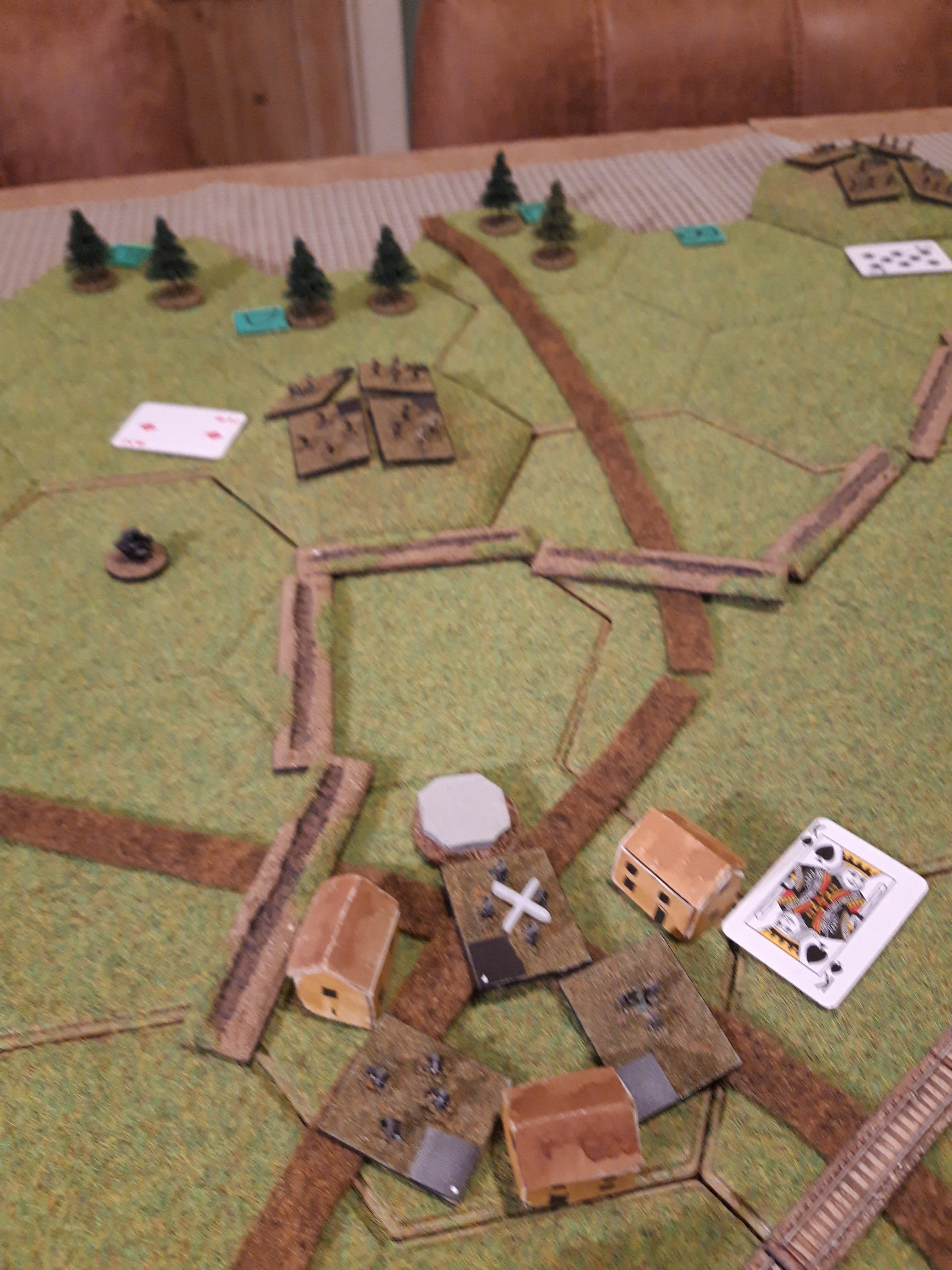
Battlefield from the east. Lindern in the foreground, with two major features, the railway line on a riased embankment to the rear, and an AT ditch snaking across the front. This is the last of the Westwall defences in this sector.


Lindern. The village is heavily fortified and garrisoned by a couple of SS panzergrenadier companies and some mortars and AT guns. The KG HQ is parked up behind the railway embankment. There was only a single battalion from 21st SS PGR in this sector, but they had so many heavy weapons it was more straightforward to model them as two small battalions, each with a weapons company. They were at full strength as they had been replenished after Arnhem, prior to taking part in the Battle of the Bulge in a few weeks time.


The north was secured by another SS KG with three companies on the heavily fortified 'Toad Hill'. This was one of the key US objectives as it outflanked the defences further north. One of the US battalions is occupying the hill opposite. The US Corps artillery shelled the German positons for two days beforehand, which cleared away any wire and mines, but the AT ditch and concrete bunkers survived.

In reserve the Germans had a small KG from 9th Panzer Division with a single company of panzergrenadiers and a platoon of Tigers from 506th SchwPzAbt. The rest of 9th Panzer was re-equipping for the Bulge. The 506th was also slated for the Bulge but supported the Westwall defences by committing odd platoons of tanks here and there, including the combat trials of the Jagdtiger. Nasty.

Tim G, Pete and Tom took the Germans.


The first wave of 335th RCT. Two infantry battalions with three rifle companies and a weapons company each.  I factored the regimental AT company into the weapons companies to keep the element count down. The US had another battalion in reserve, as well as a battalion of Shermans supported by a company of armoured engineers and two battalions of artillery, including one of 155mm howitzers.

Tim C, John, Simon, Jerry and Mark took the US.


The action opened with Jerrys battalion occupying the hill in D2. Simon stayed on A1. Both sides exchanged mortar and artillery fire. irl the US moved up under cover of darkness to their jump off points without a prep barrage to take the Germans by surprise and got very close indeed. Petes battalion in Lindern suffered some losses from US Corps artillery, despite their concrete bunkers.


Simon was content to call in artillery fire on Toad Hill for now. The US were hampered in the real battle by poor communication due to bad weather, and the US artillery in the game was quite erratic.


Both sides were lucky with their reinforcement rolls. The 9th Panzer KG came rolling down the road (rather slowly thanks to the Tigers who failed their move roll for a second hex).


And Marks US tank battalion came on, and decided to lurk in the woods at E1. I was a bit concerned at this point that the US were being too passive, but it turned out that they had a cunning plan.


Johns reserve infantry battalion and the RCT HQ now turned up, so all the US forces were now on the table. This was Jerry's cue to start marching northeast, where he came under fire from the troops in Lindern as well as German artillery fire. Meanwhile Tigers and their accompanying infantry motored onto the hill in F4.


Things started hotting up on Toad Hill. Jerrys battalion took some losses but US 155s suppressed the Germans in their concrete bunkers.


The panzers on Hill F4 were suddenly faced with a 'target rich environment' as John and Marks battalions surged forward. The Tigers picked off some Shermans.


The German defenders on Toad Hill were still suppressed and suffered some losses from artilery fire. They did however manage to repulse Simons assault from A1 - the US marched into the valley, took some fire, and promptly broke and fell back again! It was too fast for me to even take any pictures. Jerry worked his way forward however.


Over in the south, the waves of US infantry and tanks rolled on forward. Mark threw his tanks and halftracks forward in an armoured overrun attack to negate the range and armour advantage of the Tigers. He passed his morale check, and then made his movement roll....


And in the the vicious close quarter fighting the Germans were overrun! The US didn't get off lightly however, and were left at half strength, the field littered with burning Shermans and half a dozen knocked out Tigers.


Meanwhile Jerry assaulted Toad Hill, his troops had been serious attrited by German defensive fire, but an assault would negate much of the cover provided by the bunkers.


Sadly his weakened troops weren't sufficient to carry the position. The US infantry scattered and the battalion disintegrated, and the SS held on, albeit at 50% strength.


Over in the south the US found that trying to push armour through a dense forest wasn't going to work. The US troops all jammed onto hill F4, under artillery, mortar and AT fire from Lindern.


Now it was Simons turn, and his battalion set off across the valley again, covered by artillery fire. The Germans managed to inflict some more losses but the US held on.


The 105s and 155s rained down on Toad Hill, suppressing the defenders, which was good news for the US infantry. The Americans had to pass a morale check to assault, and then a movement check, hampered by the deep AT ditch.


They made it however, and in a bloody close quarters battle, both sides took heavy losses. The SS were reduced to one damaged company, while the US were down to two damaged companies. Both sides morale was maintained and they hung on grimly.


Meanwhile John pushed his infantry through the forest, while the battered tankers fell back off Hill F4. German artillery managed to knock out the last of the Shermans as they withdrew.


In a final bloody conclusion on Toad Hill, the remaining SS were destroyed and the US were left with half a battered company among the wrecked fortifications. Toad Hill had fallen! The excitement made the camera shake.


Johns troops meanwhile pressed on with their flanking manouvre, but failed their move throw to enter the rail junction (the embankment is a linear obstacle).  German mortars in Lindern chipped a hit off them.


In response, US artillery plastered Lindern, but with little material effect.


Next turn (the very last turn of the game), John managed to take the rail crossing and with both objectives firmly in US hands, it was declared a US victory.

That was a very satisfactory playtest, we rattled though the whole thing in an hour and fifteen minutes, so at VCOW the two hour slot should be long enough to allow for some preliminary blurb and a decent washup. At one point I was a bit concerned the US weren't going to make it, but it turned out they had a cunning plan, which was very effective. I also realised after the game that I kept forgetting to roll morale tests for units under artillery fire, I must make a mental note to myself for the game at COW. I'll also substitute a company of Pz IVs for the platoon of Tigers as the latter are so distracting. It is supposed to be a regimental level infantry game, not a tactical game for trackheads. The original CD scenario had also subbed Pz IVs for the Tigers, as I suspect given the terrain and the way tank combat works in CD,  a platoon of Tiger IIs would knock out all the US armour in a couple of turns.